
REVIEW · COMMUNISM HISTORY TOURS
Prague Communism History and Nuclear Bunker Tour
Prague’s recent past is under your feet. This tour links Cold War history with real places, from former secret police holding cells to the streets where the 1989 Velvet Revolution unfolded. I like the mix of outdoor walking and the one-hour bunker visit, and I especially value the personal stories some guides bring from growing up under communism. The main drawback is the amount of walking, stairs, and transport time, which may feel long if you want a quick museum visit.
I also like that the route takes you beyond Prague’s postcard center. You see socialist-era buildings, hear about the Soviet invasion of 1968, and travel to an authentic underground shelter rather than simply looking at old photographs. The quality can depend on your guide: names such as Stan, Pavel, Ladislav, Lada, Tom, Karl, and Maki have been praised for humor, clarity, and personal insight, while one poorly paced tour left a guest feeling that too much time was spent on side comments.
In This Review
- Key details before you book
- Starting at Malé Náměstí in Prague’s Old Town
- The former StB holding cells and Václav Havel
- The Velvet Revolution Memorial at Národní třída
- Wenceslas Square and the Soviet invasion of 1968
- Olšanské náměstí and socialist-era Prague
- The ride to the nuclear bunker
- Entering the bunker four floors below ground
- The guide makes or breaks the experience
- Who will get the most from the $45.16 price?
- Practical advice for a smoother tour
- Should you book the Prague bunker tour?
- FAQ
- Where does the tour start?
- Where does the tour end?
- How long does the experience last?
- Is transport to the bunker included?
- Is entrance to the nuclear bunker included?
- What language is the tour offered in?
- Is the tour suitable for people with mobility issues?
- Is the bunker suitable for people with claustrophobia?
- Can I cancel for a refund?
Key details before you book
- A four-level underground bunker: The Prague Nuclear Bunker Communism and Cold War Museum occupies a bunker hidden beneath the city.
- A walk through political Prague: You visit the former StB holding cells, the Velvet Revolution Memorial, Národní třída, and Wenceslas Square.
- Personal stories can shape the tour: Several guides have shared memories of life under communist rule, making the political history more human.
- Transport is included: The price covers transport to and from the bunker, including the public transport journey described by guests.
- Expect stairs and steady walking: This is not suitable for anyone with a walking disability or major mobility issue.
- A small maximum group: The tour can have up to 26 people, though smaller groups may feel easier for questions and movement underground.
Starting at Malé Náměstí in Prague’s Old Town
The meeting point is inside a passage at Malé Náměstí 459/11, about 20 meters to the right of Hotel U Prince. That puts you in the heart of Prague’s Old Town, close to major public transport and easy to combine with sightseeing before or after the tour.
Arrive early. The ticket office is inside the passage, not simply on an open square, and once the group leaves, joining later is not guaranteed. Online booking can be made up to 30 minutes before departure, but that is a poor plan if you need to find the passage, collect your bearings, or manage a busy sightseeing day.
The tour lasts about two hours and 20 minutes, with a possible variation of 10 to 15 minutes depending on group size. That is long enough to give the subject room, but not so long that it takes an entire day. You will spend part of the time walking through central Prague and part of it traveling to the bunker.
The English tour has a fixed language choice, and you are expected to speak the selected language. Translation during the tour is not allowed, so this is not a good fit if you need regular interpretation for someone in your group.
More communism history tours in Prague:
- Prague: Communism History and Nuclear Bunker Guided Tour
★ 4.7 · 2,417 reviews - Communism & Nuclear Bunker Tour + 70s Canteen Lunch (own expense)
★ 5.0 · 1,036 reviews - Prague: Communism and Bunker Tour with 70s Canteen Lunch
★ 4.8 · 250 reviews
The former StB holding cells and Václav Havel
The first historical stop is the former StB holding cell building. StB was the communist-era secret police, and this location gives the tour a darker physical anchor. Instead of discussing surveillance only as an abstract government policy, you are shown a building connected with detention and state control.
The stop also includes the story of former president Václav Havel. Havel is closely tied to the democratic opposition and the political changes that transformed Czechoslovakia, so this part helps connect individual courage with the larger story of regime change.
You spend about 10 minutes here. That is enough for a focused explanation, but not enough for a full museum-style examination of the building. I would treat it as a scene setter: an early reminder that communist rule affected real people, not just political speeches and official signs.
The Velvet Revolution Memorial at Národní třída
The tour then moves to the Velvet Revolution Memorial and Národní třída. These locations are important because the events of November 1989 unfolded in public streets, with students and demonstrators confronting the communist government.
Národní třída is where the recent political history of the Czech Republic becomes especially immediate. Your guide explains the events connected with the revolution, helping you understand why this ordinary-looking central street became such a powerful symbol.
A short stop here works best when the guide tells the story clearly and keeps the timeline moving. The strongest guides reported for this tour have been praised for making difficult material lively without turning it into a dry lecture. Names that come up positively include Stan, Pavel, Ladislav, Lada, Karl, and Tom, though your assigned guide may be someone else.
This section is also a good reason to take the tour early in your Prague visit. Once you know what happened at Národní třída, Wenceslas Square, and the surrounding streets, you may notice the city’s political past during later walks on your own.
Wenceslas Square and the Soviet invasion of 1968
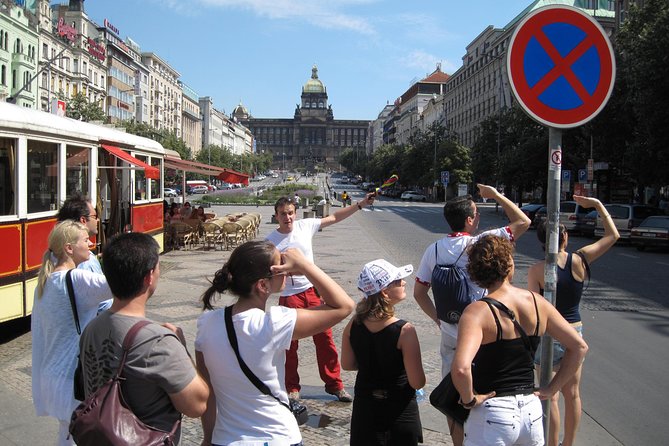
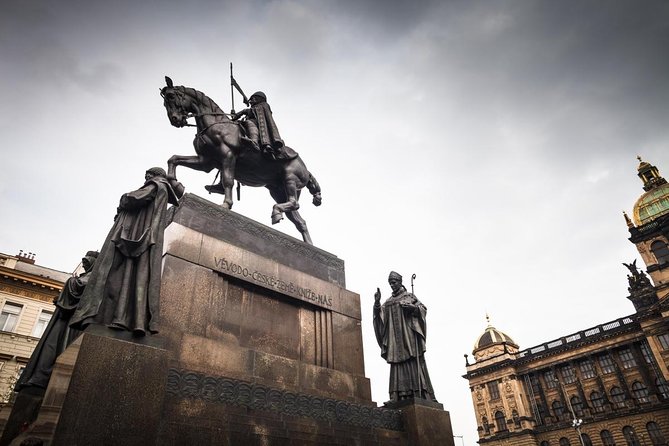
Wenceslas Square brings the story back to August 1968 and the Soviet-led invasion. You hear about Alexander Dubček and the political reform movement associated with the Prague Spring.
The value here is the contrast between hope and force. Reform-minded leaders attempted to create a less rigid form of socialism, but the invasion ended that experiment and began a period of tighter control. The square also connects the events of 1968 with later demonstrations, so your guide can show how the same public space carried different political meanings over time.
Again, the stop lasts roughly 10 minutes. Do not expect a full academic treatment of the Prague Spring, the invasion, or the years that followed. Instead, you get a compact explanation while standing in the places where the country’s public life played out.
I would pay close attention to dates and names during this portion. The tour covers a lot in a short time, moving from the postwar period to 1968, the communist decades, and 1989. The guide’s ability to keep the chronology clear matters greatly.
More History Tours in Prague:
- Prague: Oldtown, Medieval Underground & Dungeon History Tour
★ 4.2 · 8,244 reviews - Prague Old Town, Medieval Underground and Dungeon Historical Tour
★ 4.5 · 3,227 reviews - Prague: Historic City Center Bus Tour with Top Sights
★ 4.4 · 2,360 reviews - Prague Historic Pub Tour with Drinks Included
★ 5.0 · 2,084 reviews
Olšanské náměstí and socialist-era Prague
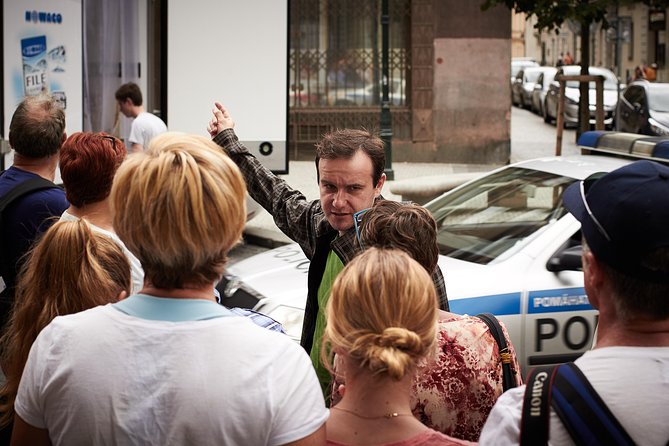
Olšanské náměstí offers a different view of Prague. Rather than focusing only on famous political sites, the route visits a former workers’ district with socialist architecture and original buildings from the concrete-building era of the 1970s.
This is one of the tour’s useful details. You see how communist rule shaped ordinary neighborhoods, not just ministries, monuments, and protest squares. The architecture can look plain, severe, or practical, but that is precisely the point. It reflects the housing and planning priorities of the period.
The stop is brief, about 10 minutes, so you will not receive a full architectural survey. Still, it gives you a chance to read the city through its buildings. If you are interested in how political systems affect daily surroundings, this may be more revealing than another grand historic facade in the Old Town.
The route also makes clear why going alone would be harder. You might pass through Olšanské náměstí without knowing which buildings carry socialist-era meaning. With a guide, the ordinary becomes evidence.
The ride to the nuclear bunker
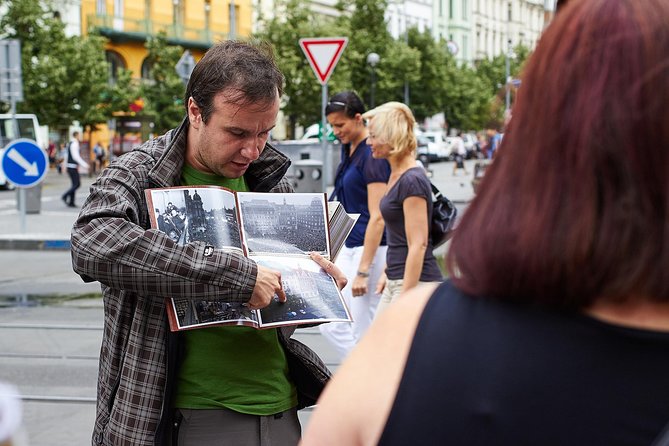
Transport to and from the bunker is included. The journey is part of the tour rather than a separate expense, and the route has included a Prague tram or similar public transport ride.
That transport time can cut both ways. I like it because you see more of the city and move from the central streets into a different setting. It also gives the guide room to add stories about communist life, political figures, and the changes that followed 1989.
On the other hand, one unhappy account felt that nearly 45 minutes of the advertised tour time went to the ride. If you measure value only by time inside historical sites, this may bother you. If you enjoy seeing how the city changes as you move beyond the center, the journey feels more useful.
Keep your expectations practical. This is a walking tour with transport, not a private vehicle excursion or a long museum visit. The public transport portion is covered, but you still need comfortable walking shoes and enough energy for the underground section.
Entering the bunker four floors below ground
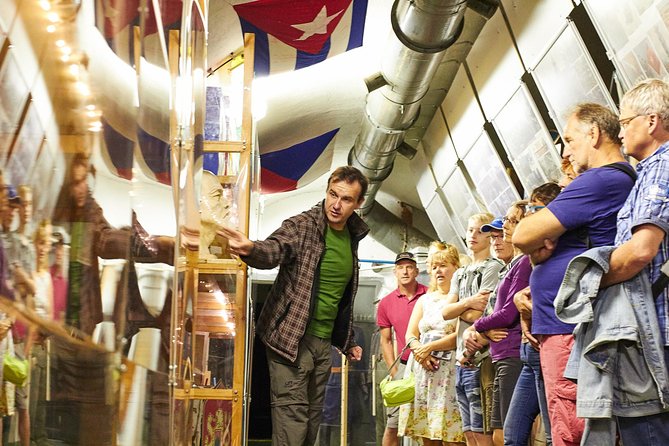
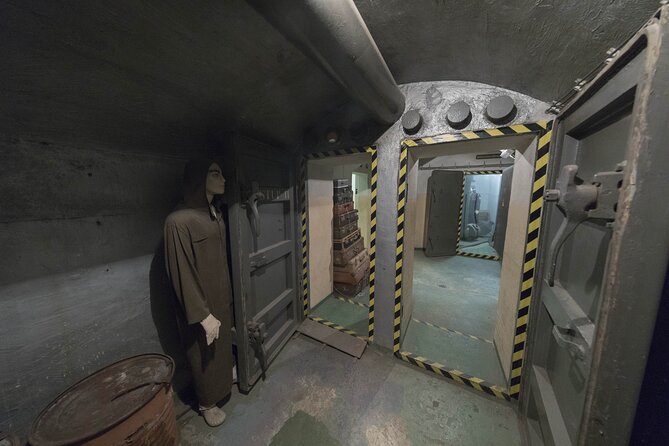
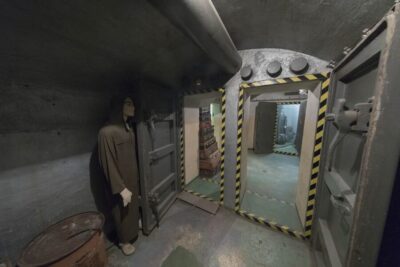
The bunker is the main event. You spend about one hour inside the Prague Nuclear Bunker Communism and Cold War Museum, located four floors underground.
The setting gives Cold War history physical weight. You are not simply hearing that people feared nuclear conflict. You are entering a space designed around that fear, with the walls, stairs, corridors, and enclosed rooms providing much of the atmosphere.
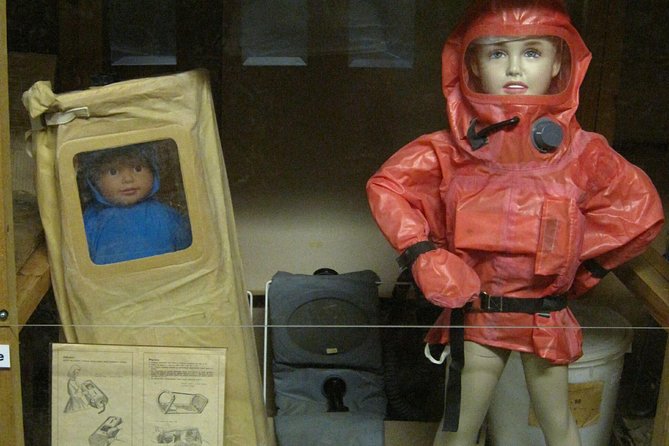
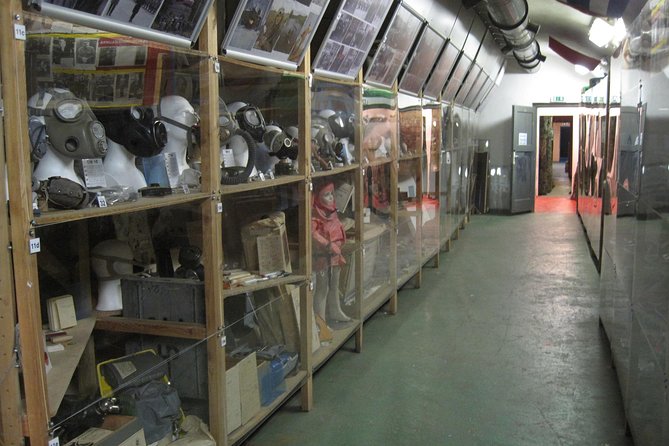
The museum display includes old mannequins and 1980s memorabilia. Some people find this direct and evocative. Others may find the collection uneven, with items that do not always feel closely connected to Czechoslovak history. I would approach it as a no-frills museum in an authentic bunker, not as a polished national institution with a large collection.
The bunker contains many steps and ramps. That matters more than the one-hour duration suggests. The enclosed setting can also be difficult if you have claustrophobia, serious heart issues, or are in a later stage of pregnancy. The operator specifically advises against the tour for people with these concerns.
Photos are allowed, but video requires special permission. That is useful to know before you start recording. The group can include up to 26 people, so movement through narrow areas may feel tighter when the tour is full.
The bunker’s strongest value comes from the explanation around it. A guide who simply points at objects may leave you wondering what daily life under communism actually felt like. A guide who explains fear, shortages, political pressure, and the choices ordinary people faced can turn the same rooms into a much stronger history lesson.
The guide makes or breaks the experience
This tour depends heavily on the person leading it. The best guides combine dates and political context with stories from their own lives or family experience. Stan has been praised for mixing personal memories with current events, while Pavel has been described as friendly and able to make Czech history fun. Ladislav and Lada have also been singled out for bringing strong personal feeling to the subject.
That personal angle is especially valuable for visitors from countries that did not live under the same system. You can learn what the government did from a book, but a guide’s account of school, work, travel, political pressure, or family decisions can help you understand how the system reached into daily life.
Still, personal passion needs structure. One poor experience involved repeated points, unrelated discussion, and a tone that felt more like an angry political speech than a balanced explanation. That criticism is worth taking seriously. If you want a careful account of official policy, contradictions within the system, and the ways people adapted, the tour may feel too blunt with the wrong guide.
The supplied photo booklet and bunker survival guide add a little value. They give you something to review later, though they should not be mistaken for a full history book.
Who will get the most from the $45.16 price?
At $45.16 per person, the cost is reasonable if you value a live guide, included transport, unusual locations, and a full afternoon-sized history experience. The bunker entrance is included, as are the booklet and survival guide. You are also paying for route planning and access to places you could easily miss alone.
The price is less attractive if you mainly want to see a bunker. The underground visit lasts about an hour, while the rest of the experience involves walking, public transport, and short outdoor stops. There are other bunkers in Czechia, so this is not the only possible way to see Cold War defenses.
I think the value is strongest for a first-time visitor who wants a guided introduction to Czech communist history. It is also a good choice if you enjoy political history, recent European history, architecture, and personal storytelling.
You may want another option if you prefer a large museum with detailed labels and a wide collection of objects. The bunker display is described as modest and somewhat mixed, so the guide’s storytelling carries much of the educational load.
Practical advice for a smoother tour
Wear comfortable shoes with good support. You will walk through central Prague, use transport, and deal with stairs and ramps in the bunker.
Do not arrive under the influence of alcohol or drugs. Smoking and pets are not allowed, and disruptive behavior, costumed groups, and bachelor parties are not accepted. These rules make sense in a confined underground setting.
Small children below school age are not allowed. The tour is also not suitable for people with walking disabilities or significant mobility problems. Most people who can walk steadily and manage stairs can participate, but the operator specifically warns against claustrophobia and serious heart conditions.
If your plans may change, cancellation is free up to 24 hours before the start time. Within 24 hours, you do not receive a refund, and changes are not accepted. The cut-off follows Prague local time.
Should you book the Prague bunker tour?
Book it if you want Prague’s communist period explained through streets, buildings, political memorials, and an actual bunker. The best version of this tour gives you more than dates. It shows how 1968, the secret police, the Velvet Revolution, and Cold War fear affected ordinary lives.
I would book it for history-minded adults, older children who can handle serious subject matter, and anyone curious about the Prague beyond its medieval center. I would skip it if you dislike stairs, enclosed spaces, public transport, or guide-led storytelling.
Your guide matters. If you get someone like Stan, Pavel, Ladislav, Lada, Karl, or Tom, the personal stories and humor may give the tour real force. Go with a clear expectation: this is a compact walking and bunker experience, not a full scholarly course. At its best, it is a memorable way to understand the city’s most recent and painful chapter.
FAQ
Where does the tour start?
It starts at the Prague Communism and Nuclear Bunker Tour ticket office inside the passage at Malé Náměstí 459/11. The passage is about 20 meters to the right of Hotel U Prince.
Where does the tour end?
The tour ends at Malé Náměstí 459/11 in Prague’s Old Town.
How long does the experience last?
The tour lasts approximately two hours and 20 minutes. The duration may vary by 10 to 15 minutes depending on group size.
Is transport to the bunker included?
Yes. Transport to and from the bunker is included in the tour price.
Is entrance to the nuclear bunker included?
Yes. Entrance to the Prague Nuclear Bunker Communism and Cold War Museum is included.
What language is the tour offered in?
The tour has a live guide and a fixed language option. You are required to speak the selected tour language, and translation into other languages is not allowed during the tour.
Is the tour suitable for people with mobility issues?
No. The tour is not suitable for people with walking disabilities or mobility issues. It includes walking, stairs, and ramps.
Is the bunker suitable for people with claustrophobia?
No. The experience is not recommended for people with claustrophobia, serious heart issues, or similar medical concerns.
Can I cancel for a refund?
You can receive a full refund if you cancel at least 24 hours before the experience begins. Cancellations or changes made within 24 hours are not accepted for a refund.
Newest listings in Prague
- World War II 4WD Tour from Prague with Lunch★ 4.4 · 3 reviews
- Prague: Historical Walking Tour with Focus on World War 2★ 4.3 · 12 reviews
- WWII and Communism History in Prague’s Old Town Private Tour★ 5.0 · 4 reviews
- Wroclaw: Giant Mountains & Valley of Palaces Day Tour★ 4.8 · 36 reviews
- Walking tour of Prague in French : Nové Město★ 4.9 · 16 reviews
- Walking tour of Prague in french: Old Town & Charles Bridge★ 4.9 · 62 reviews
- Vltava River Cruise and Private Tour of Prague’ Old Town★ 5.0 · 1 review
- Ultimate Unlimited Beer Pong with Czech Beer★ 4.6 · 5 reviews
Communism History Tours, compared.
Communism History and Nuclear Bunker Guided Tour
Read our review →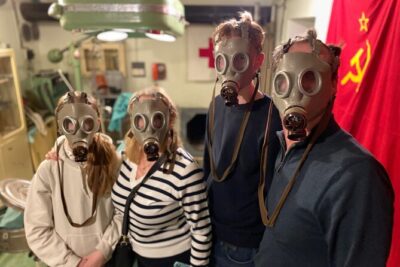
Communism & Nuclear Bunker Tour + 70s Canteen Lunch (own expense)
Read our review →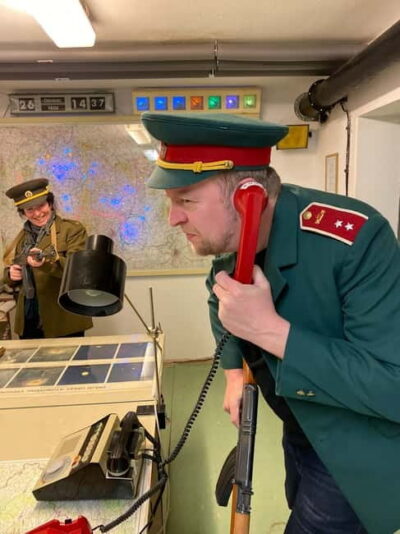
Communism and Bunker Tour with 70s Canteen Lunch
Read our review →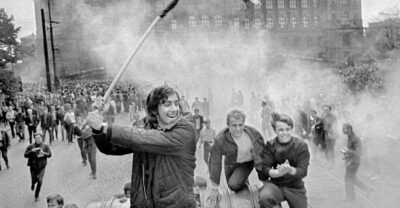
Second World War & Communism (Tip-based 3 hour tour)
Read our review →
Skip the Line: 10-Z Bunker Entrance Ticket in Brno
Read our review →
Browse the lists this tour appears in