
REVIEW · WALKING TOURS
Walking tour of Prague in French : Nové Město
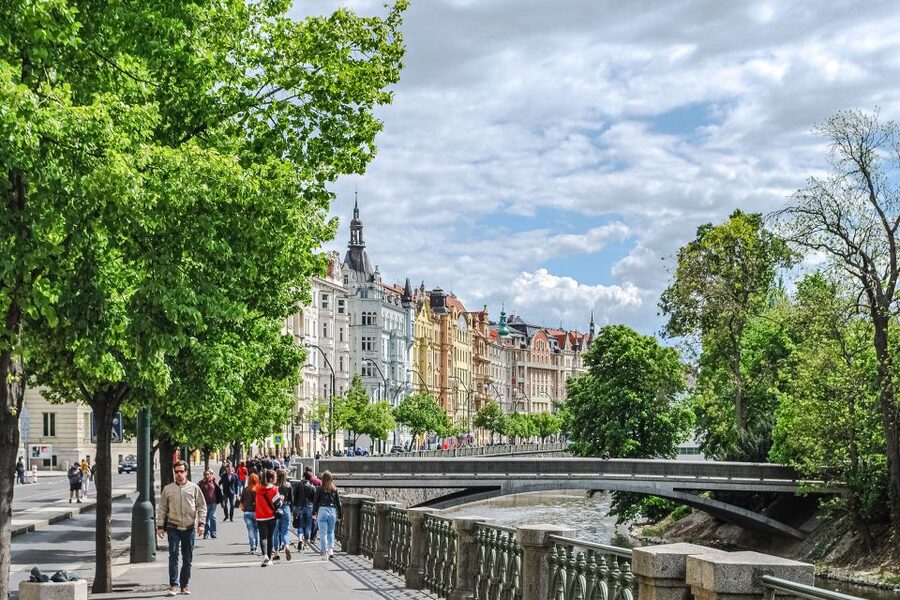
Prague’s newer town is anything but new. This 2.5-hour French-language walk brings Nové Město to life through its medieval market squares, grand national buildings, Art Nouveau details, Cubist design, and Vltava river views. I especially like the mix of architectural styles and the chance to walk beyond the usual Old Town route. The river quays and Archer’s Island also offer excellent places for photographs.
I also like that the tour connects buildings with major Czech events, from the national cultural revival to the Prague Spring and the road toward Czechoslovak independence. The main consideration is pace: with 19 stops in about two and a half hours, some locations receive a short explanation rather than a long visit, and the tour takes place in rain, snow, or sunshine.
In This Review
- Key points at a glance
- Why Nové Město makes a smart Prague walking tour
- Starting at Jindřišská Tower and Senovážné Square
- From Na Příkopě to Republic Square
- Wenceslas Square and the national revival
- Art, sculpture, and a second look at Wenceslas Square
- Charles Square and the quieter southern route
- Along the Vltava to the National Theatre
- Crossing Legion Bridge to Archer’s Island
- Architecture from Gothic to Cubist
- French guidance, timing, and practical value
- Who should book the Nové Město walk?
- Should you book it?
- FAQ
- Is the tour conducted in French?
- How long does the walking tour last?
- Where does the tour begin?
- Does the tour include hotel pickup?
- Are food, drinks, or transport tickets included?
- Does the tour operate in bad weather?
Key points at a glance
- Three medieval market centers: Learn how Charles IV planned Nové Město around the cattle market, horse market, and hay market.
- A wide range of architecture: See Gothic, Baroque, Art Nouveau, and Cubist buildings within one walk.
- French-speaking guidance: A licensed local guide explains Prague’s culture, politics, buildings, and customs in French.
- Major Czech landmarks: Visit the National Museum, National Theatre, Municipal House area, Estates Theatre area, and Wenceslas Square.
- Vltava river finale: Walk along Masarykovo nábřeží, cross Legion Bridge, and finish in Park Legií.
- Useful local advice: The guide provides area recommendations and practical suggestions for the rest of your stay.
Why Nové Město makes a smart Prague walking tour
Most first visits to Prague focus on the Old Town, Charles Bridge, and Prague Castle. That route is worthwhile, but Nové Město explains another side of the city. It is a planned district created by Charles IV in 1348, designed around large commercial centers rather than a single old square.
I like the way this tour uses urban planning as its main story. Charles IV organized the district around three central markets: the cattle market, now Charles Square; the horse market, now Wenceslas Square; and the hay market, now Senovážné Square. Those names may sound practical, even rustic, but they reveal how medieval Prague worked.
The district later became a stage for Czech cultural and political life. The National Museum and National Theatre are tied to the Czech national revival, a movement that strengthened Czech language, culture, and identity. The walk also reaches places connected with the Prague Spring and the political changes of the twentieth century.
That range gives the tour a useful shape. You are not simply moving from one pretty building to another. You are seeing how commerce, culture, national identity, and modern city life changed the same streets over time.
More Walking Tours in Prague:
- Prague: 3-Hour Walking Tour of Old Town & Prague Castle
★ 4.7 · 5,696 reviews - Prague: Ghost Walking Tour Where Legends Come To Life
★ 4.4 · 5,253 reviews - Prague: Jewish Quarter Walking Tour with Admission Tickets
★ 4.7 · 3,729 reviews
Starting at Jindřišská Tower and Senovážné Square
The meeting point is in front of the entrance to Jindřišská Tower, a clear landmark near the center of Prague. The easiest public transport approach is from Jindřišská tram stop, served by lines 3, 5, 6, 9, 14, and 24.
The first stop, Senovážné náměstí, introduces the old hay market. The planned layout of Nové Město becomes easier to understand here, especially when your guide explains how the square fitted into the district’s original commercial system.
The guided explanation at this point is listed at about ten minutes. That is enough time to get the central idea without spending too long on a single square. I would arrive a little early, since a large urban meeting area can feel confusing if you reach it at the last minute.
From Na Příkopě to Republic Square
The route continues along Na Příkopě, one of the key streets in central Prague. At Na Příkopě 864, the guide begins linking the old market district with the grand commercial and civic buildings that developed later.
Náměstí Republiky is one of the most useful stops for architecture lovers. The area brings together the Powder Tower and the Municipal House, giving you a sharp contrast between medieval Gothic form and the decorative Art Nouveau style that later shaped Prague.
The Powder Tower is one of the city’s emblematic Gothic landmarks. Nearby, the Municipal House offers a much more ornate expression of the early twentieth century. You may not enter either building during this walk, but the guide’s outdoor explanation helps you read the facades rather than simply photograph them.
The tour then reaches Ovocný trh, or Fruit Market. This stop connects naturally with the Estates Theatre area and Prague’s cultural life. The square helps show how the city’s commercial spaces gradually gained an important role in public and artistic life.
Wenceslas Square and the national revival
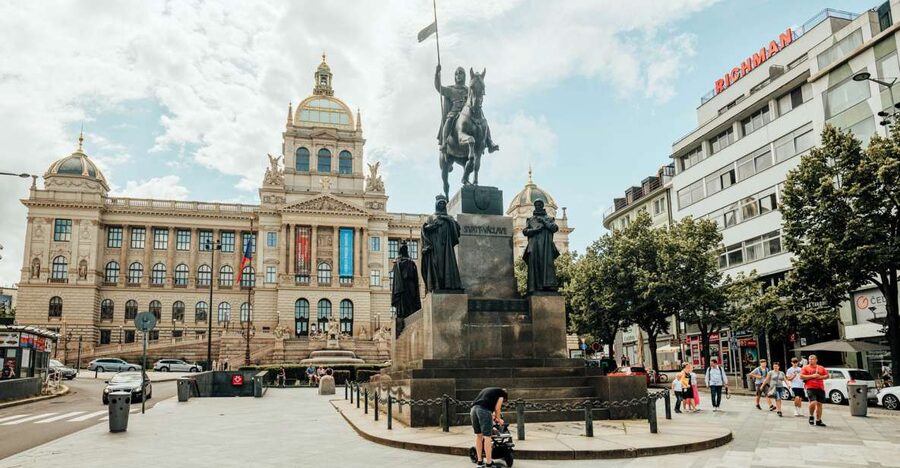
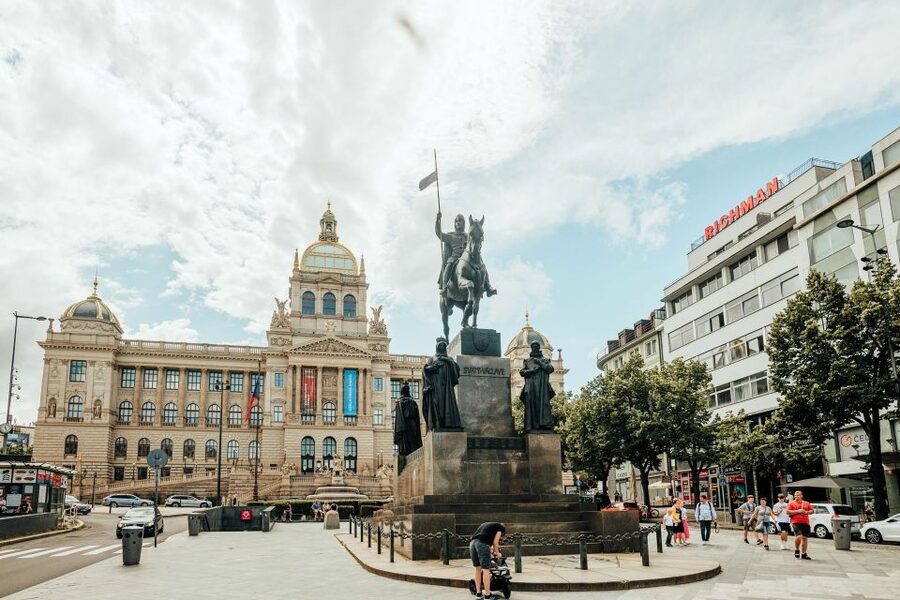
The walk reaches Václavské náměstí, or Wenceslas Square, at Václavské náměstí 826, before continuing to Jungmann Square and the Franciscan Gardens. Wenceslas Square began as the medieval horse market, but its modern importance comes from the public events that have taken place here.
The National Museum anchors the upper end of Wenceslas Square. It is one of the central buildings of the Czech national revival, and its position gives the square a strong civic character. Your guide also uses the area to discuss later political events, including the Prague Spring.
I like this part because it puts Czech history into a real public setting. Instead of treating independence and political change as distant textbook subjects, the tour points to the streets and squares where national identity was expressed.
Jungmann Square offers a shorter stop, followed by the Franciscan Gardens. The gardens provide a quieter change of pace from the broad avenues. The listed explanation here lasts around ten minutes, so you should have enough time to catch your breath while hearing more about the surrounding district.
A few more Prague options to compare
- Prague: 50-Minute Sightseeing Evening Cruise
★ 4.2 · 33,780 reviews - Prague: Medieval Dinner with Unlimited Drinks
★ 4.4 · 19,847 reviews - Prague: Skip-the-line Castle Ticket and Optional AudioGuide
★ 4.3 · 11,121 reviews - Prague: Castle Tour with Local Guide and Entry Ticket
★ 4.6 · 10,422 reviews
Art, sculpture, and a second look at Wenceslas Square
The itinerary includes a stop at a David Černý sculpture, identified as Kůň. This modern work adds a sharp contrast to the historic churches, towers, and formal civic buildings seen earlier.
The stop is brief, about five minutes. That is appropriate for a sculpture, but it also means the guide’s comments may be concise. I would use this moment to look closely at the work and consider how contemporary Prague can be playful, provocative, and very different from the city’s medieval image.
The tour then returns to Wenceslas Square for another ten-minute explanation. The repeated appearance of the square may seem unusual at first, but it allows the guide to approach it from another point and develop its historical meaning after you have seen more of Nové Město.
This is also a good place to remember that the tour is mainly a street-level history walk. You are not promised museum entries or extended time inside monuments. The value comes from the guide’s explanations and from seeing how the sites relate to each other.
Charles Square and the quieter southern route
From Wenceslas Square, the route heads toward Sokolská and Na Rybníčku. These stops are shorter, with about five minutes at each. They help connect the central commercial area to the southern part of Nové Město.
Charles Square receives a longer explanation, around ten minutes. Originally the cattle market, it is one of the clearest examples of Charles IV’s ambitious planning. Its size helps you imagine the scale of the medieval district and the practical reason for creating separate market centers.
The route does not treat Nové Město as a collection of isolated attractions. It shows how the markets, streets, and civic buildings fit into one planned extension of Prague. That wider view is one of the strongest reasons to choose this walk instead of visiting each landmark without context.
The walk then reaches Resslova, another point where the guide can connect the district with more recent Czech events and national memory. The stop is listed at about ten minutes, giving the guide room to explain more than just the building facades.
Along the Vltava to the National Theatre
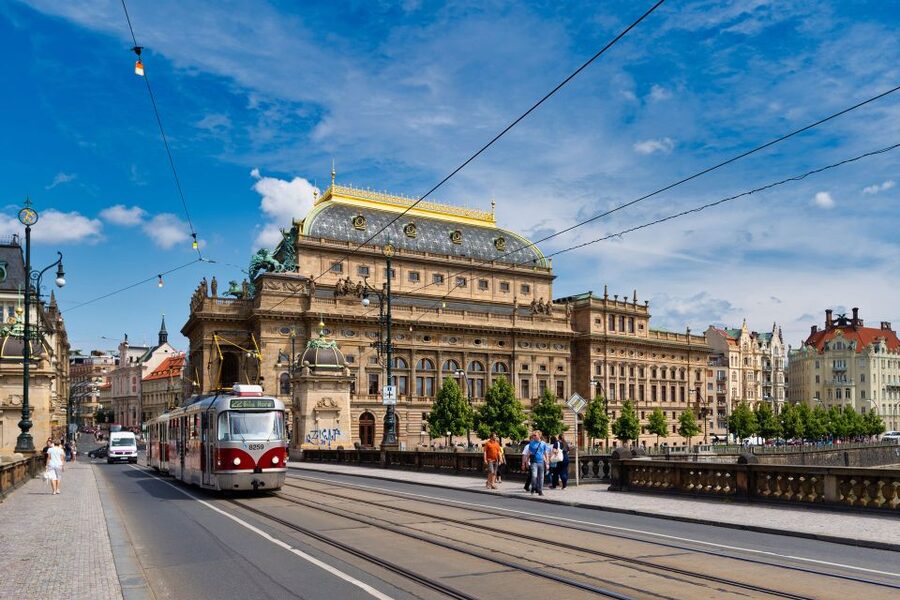
The final section shifts toward the river. At Masarykovo nábřeží, the tour follows the Vltava quays before reaching the National Theatre.
This change in scenery matters. After a series of squares and city streets, the river opens the view and gives you a different sense of Prague’s layout. The walk along the quays is also one of the best parts for photography, especially if you enjoy combining historic architecture with water and bridges.
The National Theatre is one of the most important buildings of the Czech national revival. Its role goes beyond appearance. It represents the effort to create major Czech cultural institutions during a period when national language and identity were becoming increasingly important.
The guide may also discuss the relationship between the theatre, the riverfront, and the wider city. Because the tour is in French, this section can be especially useful if you want historical context without relying on an English-language explanation or a written guide.
Crossing Legion Bridge to Archer’s Island
The route continues to Legion Bridge and Park Legií. The bridge stop lasts about five minutes, while the park receives around ten minutes.
This is where the Vltava part of the walk reaches its most scenic point. The itinerary specifically includes time on Archer’s Island, giving you a chance to enjoy river views and take photographs away from the tight streets of the central district.
I would save a little camera space for this section. The tour’s focus is not only monuments and dates. It also gives you a chance to see Prague from the river, with bridges, quays, and the city’s historic profile arranged from a more open viewpoint.
The supplied meeting information says the activity finishes at Park Legií, while another note says it ends back at the meeting point. Since those details do not match exactly, confirm the final location when you book or when you meet the guide. Either way, the route is designed to finish in the river and bridge area rather than at the original tower.
Architecture from Gothic to Cubist
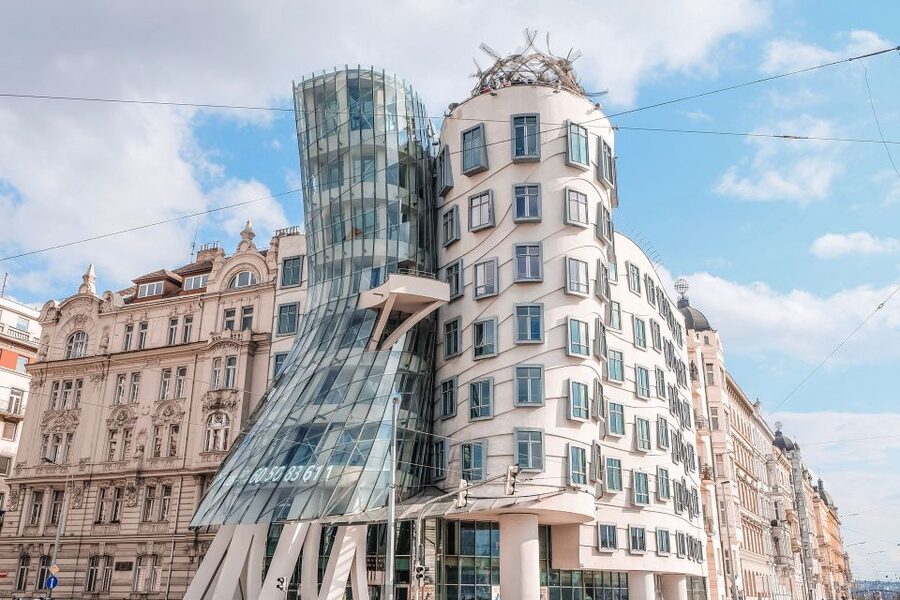
This tour works particularly well for anyone who likes buildings but does not want to spend a full day inside museums. In a short distance, you encounter Gothic elements at the Powder Tower, Baroque and historicist details across the city center, Art Nouveau decoration at the Municipal House, and Cubist design associated with the House of the Black Madonna.
The architectural variety is not presented as a random collection. It reflects different periods of Prague’s growth. Medieval trade shaped the market squares. The national revival produced major cultural buildings. Later styles changed the city’s commercial streets and public spaces.
The House of the Black Madonna is especially useful for understanding Prague’s Cubist side. It reminds you that the city’s design history is not limited to Gothic towers and ornate nineteenth-century buildings.
You should also expect plenty of outdoor explanations rather than formal architectural lectures. The guide is there to make the city readable, point out important details, and explain why the buildings matter.
French guidance, timing, and practical value
The tour costs $27 per person and lasts about 2.5 hours. For that price, I consider it a fair choice if you want a structured introduction to Nové Město, especially because it combines history, architecture, local culture, and practical advice.
The value is strongest for French-speaking visitors who want a live guide rather than an audio app. The guide is licensed by the Czech Ministry of Tourism and provides explanations of the sites, Prague’s history, Czech culture, useful addresses, and suggestions for the rest of your stay.
The itinerary includes many stops, but most are brief. That makes the tour lively and varied, though it may feel fast if you want long periods for photography or detailed discussion at every building.
No transport tickets, food, drinks, hotel pickup, or hotel return are included. Plan to reach Jindřišská Tower independently and wear shoes suitable for 2.5 hours of city walking. The tour operates in all weather, including rain, sunshine, and snow, so check the forecast and dress accordingly.
Free cancellation is available up to 24 hours before the tour for a full refund. You can also reserve now and pay later, which is useful if your Prague schedule is still changing.
Who should book the Nové Město walk?
I would recommend this tour to French-speaking visitors who have already seen the main Old Town sights or want a broader first look at Prague. It is also a good fit if you enjoy architecture, public squares, Czech national history, and river views in equal measure.
Families and first-time visitors may appreciate the clear route and frequent changes of scene. History-minded visitors will get the most from the explanations of Charles IV, the national revival, the Prague Spring, and the events tied to Wenceslas Square.
I would think twice if you want lengthy interior visits, a slow photography tour, or a walk focused only on the city’s most famous monuments. The schedule moves through many locations, and several stops last only five or ten minutes.
The experience has a 4.9 rating from 16 reviews, including especially warm praise for the explanations, the engaging presentation, and the chance to see another side of Prague. That matches the tour’s main strength: it turns an often-overlooked district into a clear story about markets, architecture, culture, and national identity.
Should you book it?
Book this French-language walk if you want context rather than a checklist. For $27, you receive a licensed local guide, a well-planned route through Nové Město, river and bridge views, and advice that can help shape the rest of your stay.
The best reason to choose it is the range. You move from Jindřišská Tower and medieval market planning to the Powder Tower, Municipal House, Wenceslas Square, Charles Square, the National Theatre, and the Vltava. Just remember that this is an outdoor walking tour in every kind of weather, and confirm the exact finishing point because the meeting notes describe it differently.
FAQ
Is the tour conducted in French?
Yes. The tour includes a live French-speaking guide.
How long does the walking tour last?
The walking tour lasts approximately 2.5 hours.
Where does the tour begin?
The tour begins in front of the entrance to Jindřišská Tower. The nearby Jindřišská tram stop is served by lines 3, 5, 6, 9, 14, and 24.
Does the tour include hotel pickup?
No. Hotel pickup and return are not included.
Are food, drinks, or transport tickets included?
No. Food, drinks, and public transport tickets are not included in the price.
Does the tour operate in bad weather?
Yes. The tour takes place in rain, sunshine, or snow, so dress for the forecast.
Newest listings in Prague
- World War II 4WD Tour from Prague with Lunch★ 4.4 · 3 reviews
- Prague: Historical Walking Tour with Focus on World War 2★ 4.3 · 12 reviews
- WWII and Communism History in Prague’s Old Town Private Tour★ 5.0 · 4 reviews
- Wroclaw: Giant Mountains & Valley of Palaces Day Tour★ 4.8 · 36 reviews
- Walking tour of Prague in french: Old Town & Charles Bridge★ 4.9 · 62 reviews
- Vltava River Cruise and Private Tour of Prague’ Old Town★ 5.0 · 1 review
- Ultimate Unlimited Beer Pong with Czech Beer★ 4.6 · 5 reviews
- Traditional Czech Food and Prague Old Town Private Tour★ 4.7 · 2 reviews
Walking Tours, compared.
3-Hour Walking Tour of Old Town & Prague Castle
Read our review →
Ghost Walking Tour Where Legends Come To Life
Read our review →
Jewish Quarter Walking Tour with Admission Tickets
Read our review →
Prague Guided Walking Tour and Cruise with Authentic Czech Lunch
Read our review →
Old Town and Jewish Quarter Guided Walking Tour
Read our review →
Prague Ghost and Legend of Old Town Walking Tour
Read our review →
Prague 3-hour Afternoon Walking Tour including Prague Castle
Read our review →
Ghosts and Legends Nighttime Guided Walking Tour
Read our review →Browse the lists this tour appears in