
REVIEW · COMMUNISM HISTORY TOURS
Prague Cold War Walking Tour
Prague’s past still speaks. This three-hour Cold War walking tour takes you beyond the pretty squares and church towers into the political story that shaped modern Czechia. With a historian, a group capped at eight people, and tram tickets included, you visit former Communist power centers, propaganda sites, protest landmarks, and places tied to the Velvet Revolution.
I like the small group size, which should make a serious historical discussion easier than it would be on a large city tour. I also like the route’s unusual stops, especially Klement Gottwald’s former mausoleum, the nuclear shelter corridors near Žižkov, and the site of Stalin’s vanished monument.
The main drawback is the climb to Vítkov Hill. Reaching the monument involves 20 to 30 minutes of uphill walking, so this is not the best choice if steep streets are a problem. A private city-center version without Vítkov Hill is available for those who need an easier route.
In This Review
- Key points about Prague’s Cold War tour
- Why this tour adds another layer to Prague
- Beginning near St. Joseph Church and the shelter corridors
- The long climb to Vítkov Hill
- Žižkov Television Tower and the city’s modern edge
- Wenceslas Square and the sudden force of public protest
- The Lennon Wall and Letná’s vanished Stalin
- An ironic statue to close the political story
- A small group makes the history more useful
- What the price includes and what it does not
- Who should book this experience?
- Should you book the Prague Cold War Walking Tour?
- FAQ
- How long is the Prague Cold War Walking Tour?
- What time does the tour start?
- Where does the tour begin?
- What language is the tour offered in?
- How many people can join the tour?
- Are tram tickets included?
- Is admission to the National Monument at Vítkov included?
- How difficult is the walking?
- Is hotel pickup included?
- What is the cancellation policy?
Key points about Prague’s Cold War tour
- Communist Prague in three hours: The tour links politics, architecture, propaganda, protest, and daily life into one focused walk.
- A historian leads the way: Guide Vadim received especially strong praise for creating a sophisticated discussion of communism in the Czech lands.
- The Vítkov climb matters: The National Monument and Gottwald mausoleum are major stops, but reaching them requires a sustained uphill walk.
- You see places most city tours skip: Expect nuclear shelter doors, a former embalming laboratory, a vanished Stalin statue site, and an ironic modern sculpture.
- Tram tickets are included: Public transport helps connect the separated parts of the route.
- The group is limited to eight: That is a real advantage for questions and conversation, particularly on a political subject.
Why this tour adds another layer to Prague
Prague can be easy to read as a city of medieval lanes, Baroque churches, and grand cafés. That picture is accurate, but incomplete. The 20th century left its mark in less decorative ways: monumental statues, Communist slogans, military parades, sealed shelters, and public squares where political power changed hands.
This tour helps you read those signs. You are not simply looking at buildings. You are considering how the Communist Party used monuments, national symbols, public space, and historical memory to support its rule.
The focus is Czechoslovakia during and after the Cold War, with special attention to the Communist Party of Czechoslovakia, known as the KSČ. You learn about the 1948 takeover, often called the elegant coup, and how the new government presented itself through Soviet imagery and carefully chosen public ceremonies.
The final sections deal with the Velvet Revolution and its continuing echoes in the Czech Republic. That gives the tour a useful shape. It begins with Communist power, moves through its symbols and institutions, and ends with public opposition and political change.
At $126.43 per person, this is not a cheap general sightseeing walk. You are paying for a specialist subject, a historian, a small group, and a carefully connected route. The value depends on your interests. If you want a standard introduction to Prague, the price may feel high. If you want a serious look at the city’s modern political past, the focused content can justify it.
More communism history tours in Prague:
- Prague: Communism History and Nuclear Bunker Guided Tour
★ 4.7 · 2,417 reviews - Prague Communism History and Nuclear Bunker Tour
★ 5.0 · 1,742 reviews - Communism & Nuclear Bunker Tour + 70s Canteen Lunch (own expense)
★ 5.0 · 1,036 reviews
Beginning near St. Joseph Church and the shelter corridors
The tour begins at St. Joseph Church, with the listed meeting point at Náměstí Republiky 1077/2 in Prague’s New Town. Confirm the exact meeting instructions when your booking is accepted, since the route description names St. Joseph Church while the meeting details give the Náměstí Republiky address.
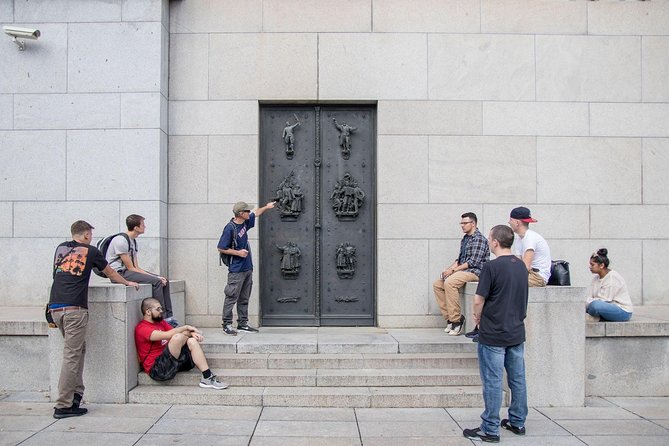
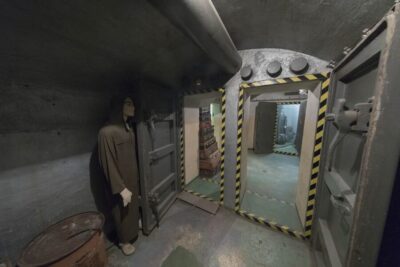
One of the first stops is the pedestrian tunnel connecting Karlín and Žižkov. At first, it may seem like a plain bit of city infrastructure. Look more closely at the locked doors along the passage. They lead toward nuclear bomb-shelter corridors built during the Cold War and still maintained.
You do not need a museum display to understand the mood of the period. These sealed entrances offer a physical reminder of the fear behind the era’s politics. Governments planned for nuclear conflict while ordinary people lived with the possibility of sudden catastrophe.
This stop is brief, around 10 minutes, but it sets the tone well. It shows how the tour uses existing places rather than relying only on famous attractions. You are asked to notice what is still present, even when the original purpose is no longer obvious.
The long climb to Vítkov Hill
The largest block of time is devoted to the National Monument at Vítkov. Allow roughly an hour for this part of the route, including the climb and discussion. The hill is one of the tour’s strongest historical stops, but it is also the part that demands the most from you physically.
The ascent takes about 20 to 30 minutes uphill. You should wear comfortable shoes and be prepared for a steady climb. The tour requires moderate physical fitness, and the hill can change the experience for anyone who dislikes steep walking.
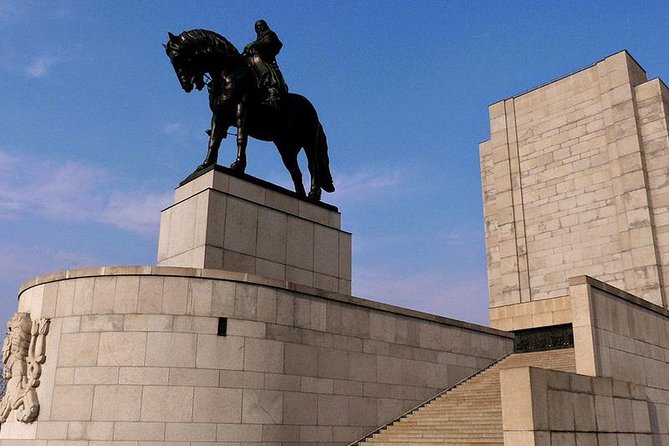
At the top, the National Monument connects Czech and Slovak memory from the First World War with later Communist ceremony. The Hall of the Soviet Soldier contains distinctive statuary and decoration linked to the political period after 1948. Your guide explains how the KSČ used visual symbols and public spaces to present its version of history.
The former mausoleum of Klement Gottwald is the most striking stop here. Gottwald was the first chairman of the Communist Party of Czechoslovakia and later became its general secretary and chairman. His mummified body was displayed in the mausoleum, following the model of other Communist leaders whose bodies became objects of state ceremony.
The adjoining laboratory, where his body was embalmed, adds an unsettling practical detail. It reminds you that political myth was built not only with speeches and statues, but also through elaborate treatment of a leader’s remains.
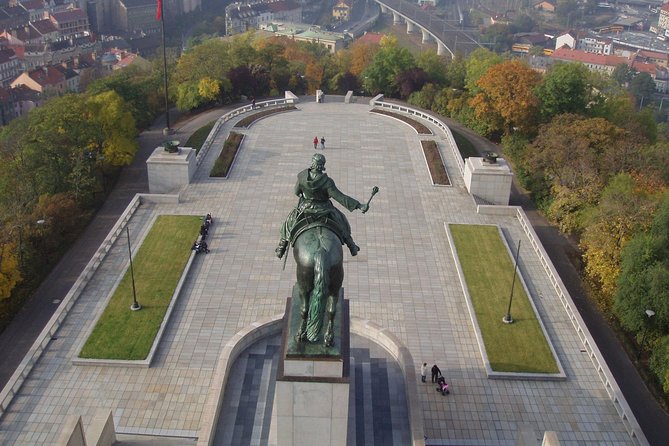
The monument to Jan Žižka provides another important contrast. The huge bronze equestrian statue is described as the third-largest of its kind in the world. It commemorates a major Czech military figure and helps explain the role of Czech nationalism under Communist rule.
This is where the tour becomes more subtle than a simple story of Soviet control. Communist power in Czechoslovakia also tried to present itself as the defender of national history. The guide’s job is to show how those two ideas, Czech identity and Communist ideology, were joined together.
Admission to the National Monument is not included in the tour price. The supplied details do not specify the admission charge, so you should check the current cost before booking if you want to plan your budget precisely.
Žižkov Television Tower and the city’s modern edge
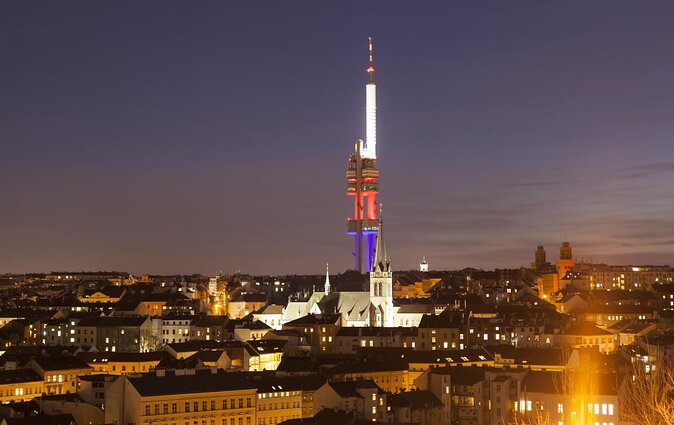
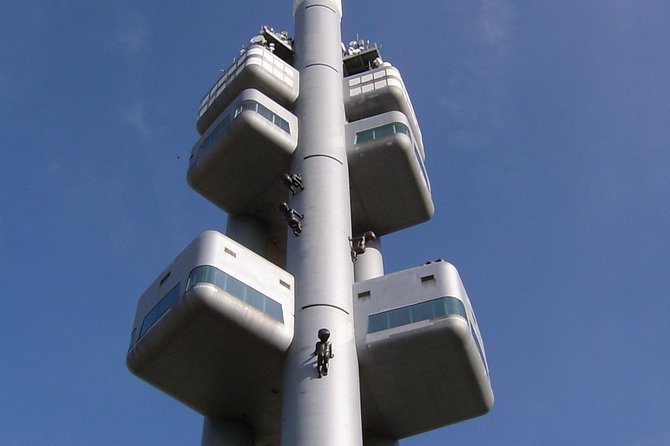
After Vítkov, the route gives you a short look at the Žižkov Television Tower. The stop lasts about five minutes and is mainly a chance to view the tower’s Brutalist design.
This is a useful visual pause after the historical weight of the monument and mausoleum. The tower is a blunt, concrete-and-steel reminder that Prague’s modern architecture does not fit neatly into its postcard image.
The tour does not list admission to the tower itself as included. You are getting the exterior view, not a tower visit. That keeps the stop quick and lets the route move on, but you should not book this experience expecting a long architecture tour or time on the observation deck.
The tower also helps you see how the tour connects different decades. The Cold War story is not confined to one monument. It appears in shelters, public buildings, monumental art, urban design, and the city’s changing skyline.
More Walking Tours in Prague:
- Prague: 3-Hour Walking Tour of Old Town & Prague Castle
★ 4.7 · 5,696 reviews - Prague: Ghost Walking Tour Where Legends Come To Life
★ 4.4 · 5,253 reviews - Prague: Jewish Quarter Walking Tour with Admission Tickets
★ 4.7 · 3,729 reviews - Prague Guided Walking Tour and Cruise with Authentic Czech Lunch
★ 5.0 · 3,627 reviews
Wenceslas Square and the sudden force of public protest
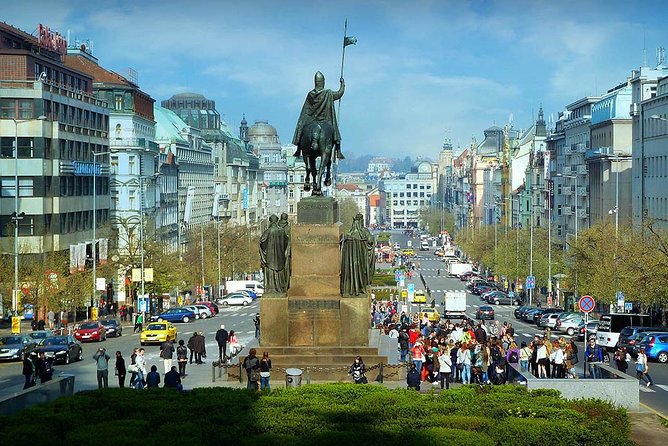
Wenceslas Square brings the tour back into central Prague and gives the political story its most dramatic public setting. The square has a long history reaching back to its founding in the 14th century, but its modern meaning comes from the events held there.
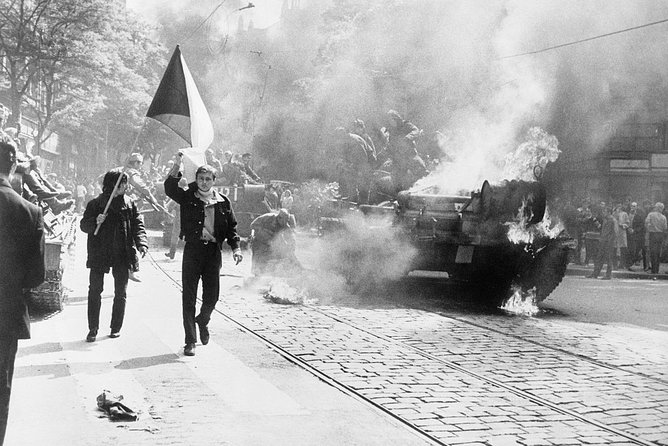
You hear about military parades by occupying powers, the Prague Spring, and the gatherings that led to the Velvet Revolution. The square was not simply a backdrop. It was a stage on which the state displayed control, and later a place where citizens showed that control was failing.
The tour describes the Velvet Revolution as igniting in a single day. By the end of the experience, you should have a clearer sense of how Communist rule weakened, how public opposition gathered force, and why Wenceslas Square remains central to Czech political memory.
The stop takes about 20 minutes. That is enough for a focused explanation, though not enough for an extended visit to every nearby site. If you want photographs, take them quickly and keep listening. The value here lies in the connection between the square’s physical size and its role in national events.
The wider route also includes the National Assembly building, formerly the seat of the Communist government. Passing this building adds an institutional side to the story. Wenceslas Square shows public gatherings, while the Assembly represents the machinery of rule behind them.
The Lennon Wall and Letná’s vanished Stalin
The route’s broader description includes the John Lennon Wall, an important site of political protest. Its significance comes from the way public writing, music, and imagery challenged official control. You see how a wall could become a place for dissent when formal political speech was restricted.
The Lennon Wall also keeps the tour from becoming only a story about Communist officials and state monuments. It shifts attention toward ordinary people and the symbols they used to express frustration, hope, and opposition.
Letná Hill adds another layer. It was once home to an enormous statue of Joseph Stalin, one of the clearest examples of monumental Communist propaganda in Prague. The statue is gone, but the site remains useful because the absence itself tells part of the story.
Your guide also recounts the tragic story of the sculptor. That personal angle matters. Large political monuments may look permanent, but the people who built them lived under pressure and could suffer when the political mood changed.
The time spent at these places can vary because the tour has a fixed length of about three hours and must connect several parts of the city. The detailed stop list emphasizes Vítkov, Wenceslas Square, Žižkov Television Tower, and the upside-down statue, while the broader route description also includes Letná, the Lennon Wall, and the National Assembly. Confirm the final route if one of these sites is especially important to you.
An ironic statue to close the political story
The final listed stop is the upside-down statue of King Wenceslas riding a dead horse. This modern sculpture uses humor and discomfort to comment on political life in Central Europe.
It is a fitting end because the tour has moved from official monuments to protest art. At Vítkov, leaders and national heroes were presented in monumental form. Here, a familiar royal image is turned into an ironic contemporary statement.
The stop lasts about five minutes, so you will not spend long analyzing the sculpture. Still, it leaves you with a question that the tour has raised throughout: who controls the meaning of public symbols, and how quickly can that meaning change?
The final destination is listed simply as Prague, Czechia, rather than one precise ending address. Make sure you have enough time afterward for your next plan, especially if you need to reach a timed reservation.
A small group makes the history more useful
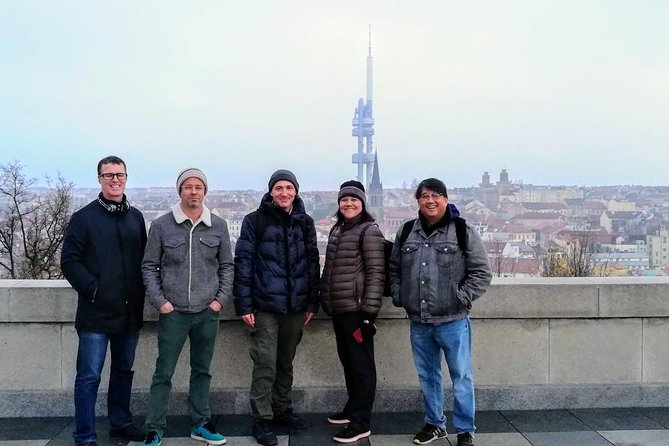
The maximum group size is eight people. That is especially helpful on a tour built around questions rather than quick facts. You can ask about ideology, Czech nationalism, the Prague Spring, the Velvet Revolution, or the way public monuments were used without trying to speak over a crowd.
The guide is a major part of the experience. Vadim received especially strong praise for providing a sophisticated and intellectual discussion of communism in the Czech lands. That description suggests the tour is best for people who want analysis, not just a list of dates.
The guide’s historical role is also important because several stops can be confusing without context. A locked shelter door is just a locked door unless someone explains why it was built. A missing Stalin statue is just an empty site unless you understand what once occupied it and why the monument mattered.
The tour is offered in English and has morning or afternoon departure options, although the supplied meeting details give a 2:00 pm start. Tell the provider your preferred departure time when booking, then confirm the final time in your booking confirmation.
What the price includes and what it does not
The $126.43 price includes the historian guide and tram tickets. Food and drinks are not included, and there is no hotel pickup or drop-off.
The included tram tickets matter because the stops are spread across Prague. You are not paying for a private vehicle, but you also are not expected to arrange every public transport connection yourself. The combination of walking and trams suits the subject, since it lets you see the city as a functioning place rather than as a string of isolated monuments.
Still, the cost is substantial for a three-hour walking experience. The strongest value comes from the guide’s subject knowledge, the small group, and access to unusual historical locations. I would choose it over a cheaper general Communist-themed walk if I wanted serious interpretation and a compact route.
I would not choose it if your main goal is architecture, shopping, or classic Prague sightseeing. The tour is focused and political. Its pleasure comes from understanding how the city changed, not from checking off the Charles Bridge or Prague Castle.
Who should book this experience?
I would recommend this tour to you if you:
- Want a focused introduction to Communist Czechoslovakia
- Enjoy political and modern history
- Prefer small groups to large guided walks
- Like asking questions and discussing ideas
- Are comfortable with a 20 to 30 minute uphill climb
- Have already seen Prague’s main medieval sights
It may not suit you if you have limited mobility, dislike serious historical discussion, or want a relaxed walk with plenty of free time. The Vítkov section is a real physical consideration, not a minor footnote.
If the hill is the only concern, ask about the private alternative that leaves out Vítkov and concentrates on Cold War sites in the city center. The supplied information says this option avoids the ascent, but it does not provide its price or exact route.
The experience has a top rating from nine published reviews, with particular praise for Vadim’s intellectual approach. That is a small sample, so I would not treat the rating as a guarantee. Still, the praise points to the tour’s central strength: a guide who can turn scattered sites into a clear political story.
Should you book the Prague Cold War Walking Tour?
Book it if you want to understand the Prague behind the fairy-tale streets. The former mausoleum, nuclear shelter corridors, Stalin statue site, Lennon Wall, National Assembly, and Wenceslas Square give you a much sharper view of the city’s 20th century.
The best reason to book is the combination of specialist history and a group of no more than eight. The main reason to hesitate is the price, along with the steep Vítkov climb.
For history-minded visitors who have already covered Prague’s classic sights, this is a strong choice. For a first-time visitor seeking a broad city orientation, spend your money elsewhere first, then return to this tour when you are ready to look beneath the surface.
FAQ
How long is the Prague Cold War Walking Tour?
The tour lasts approximately three hours.
What time does the tour start?
The listed start time is 2:00 pm. Morning and afternoon departures are also offered, so you should state your preferred departure time when booking.
Where does the tour begin?
The meeting details give Náměstí Republiky 1077/2 in Prague’s New Town as the starting point. The route description also names St. Joseph Church as the beginning, so confirm the exact meeting instructions after booking.
What language is the tour offered in?
The tour is offered in English.
How many people can join the tour?
The group has a maximum of eight participants.
Are tram tickets included?
Yes. Tram tickets are included in the tour price.
Is admission to the National Monument at Vítkov included?
No. Admission to the National Monument is not included.
How difficult is the walking?
You should have a moderate level of physical fitness. The route includes a 20 to 30 minute uphill climb to the Vítkov Hill monument. A private alternative without that climb is available.
Is hotel pickup included?
No. You make your own way to the meeting point, and hotel drop-off is not included.
What is the cancellation policy?
You can cancel up to 24 hours before the start time for a full refund. Changes or cancellations made less than 24 hours before the start are not accepted for a refund.
Newest listings in Prague
- World War II 4WD Tour from Prague with Lunch★ 4.4 · 3 reviews
- Wroclaw: Giant Mountains & Valley of Palaces Day Tour★ 4.8 · 36 reviews
- Prague: Historical Walking Tour with Focus on World War 2★ 4.3 · 12 reviews
- WWII and Communism History in Prague’s Old Town Private Tour★ 5.0 · 4 reviews
- Walking tour of Prague in French : Nové Město★ 4.9 · 16 reviews
- Walking tour of Prague in french: Old Town & Charles Bridge★ 4.9 · 62 reviews
- Vltava River Cruise and Private Tour of Prague’ Old Town★ 5.0 · 1 review
- Ultimate Unlimited Beer Pong with Czech Beer★ 4.6 · 5 reviews
Communism History Tours, compared.
Communism History and Nuclear Bunker Guided Tour
Read our review →
Prague Communism History and Nuclear Bunker Tour
Read our review →
Communism & Nuclear Bunker Tour + 70s Canteen Lunch (own expense)
Read our review →
Communism and Bunker Tour with 70s Canteen Lunch
Read our review →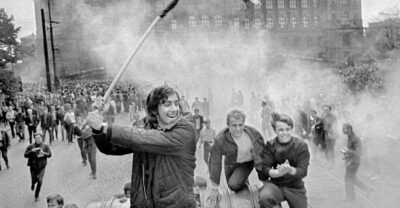
Second World War & Communism (Tip-based 3 hour tour)
Read our review →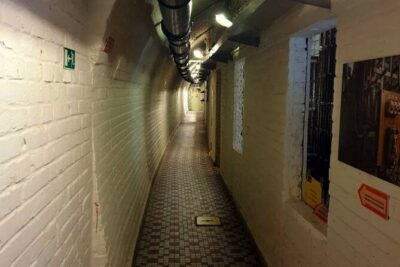
Skip the Line: 10-Z Bunker Entrance Ticket in Brno
Read our review →Browse the lists this tour appears in