REVIEW · PRAGUE TOURS
The Plague Doctor of Prague
Prague gets wonderfully eerie after dark. The Plague Doctor of Prague turns a short walk through the Old Town into a lively lesson on disease, faith, medicine, and daily life in 1715. I especially like the small-group setting and the way guides such as Thomas, David, Oscar, Oskar, and Maddie use humor without losing sight of the suffering caused by the plague. The tour also visits places many standard city walks pass quickly, including the old hospital area and St. Agnes Convent.
The other strong point is its broad human focus. You learn about quarantine, merchants, doctors, Jewish communities, wealthy families, and ordinary people rather than hearing only a list of dates. The main consideration is that this is a themed performance as much as a history walk, so anyone wanting a strictly academic account may find parts too light or feel the historical thread needs more detail.
In This Review
- Key points before you book
- What this Prague plague walk actually offers
- Starting at the House of the Golden Well
- Klementinum, the New Town Hall, and quarantine
- Old Town Square and the merchants of Prague
- Kafka, Jewish Prague, and Albert Camus
- The old hospital at Na Františku
- St. Agnes Convent and the final group photograph
- How the guides shape the experience
- Walking effort, timing, and weather
- Is $26.61 a fair price?
- Who should book this tour?
- Should you book The Plague Doctor of Prague?
- FAQ
- How long does The Plague Doctor of Prague last?
- Where does the tour begin?
- Where does the tour end?
- What language is the tour offered in?
- How much does the tour cost?
- How many people can join the tour?
- Is the tour suitable for most fitness levels?
- Can I cancel for a refund?
Key points before you book
- A 1715 setting: The tour introduces Alexander Schamsky, Prague’s plague doctor, and focuses closely on the plague years of 1713 to 1715.
- Six stops across the Old Town: You move from Karlova Street through major squares, the Jewish Quarter, the former hospital area, and St. Agnes Convent.
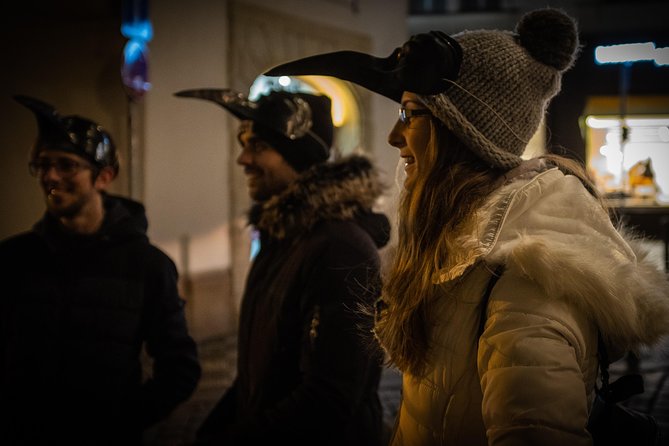
- History with theatrical humor: The guide stays in character, wears a plague doctor costume, and uses spooky stories and jokes to make difficult material easier to follow.
- Strong for families and teens: Children, teenagers, adults, history fans, medical workers, and people interested in public health can all find something here.
- A compact evening walk: The experience lasts about 90 minutes and covers a manageable amount of ground.
- Good value at $26.61: For a small-group English tour with a distinctive theme and six locations, the price is fair, especially if you want more than Prague’s usual architecture tour.
What this Prague plague walk actually offers
This is not a haunted house attraction, and it is not a standard sightseeing walk with a costume added at the last minute. The guide uses the plague doctor character to frame a serious look at how people understood illness before modern medicine.
The experience is offered in English and uses a mobile ticket. The advertised group limit is 10 people, which matters here. A plague doctor performance loses some of its effect if you are standing in a large crowd, unable to hear the guide. A small group also gives you a better chance to ask questions and follow the guide through narrow streets.
The tour has earned a 4.9 rating from 126 reviews, with 98 percent of participants recommending it. That strong response makes sense when you understand the balance. The best guides, including Thomas and David, are praised for clear explanations, comic timing, and attention to the group. They make the subject accessible without turning it into a silly costume show.
You should still set your expectations correctly. The tour covers a lot in 90 minutes. It touches on plague outbreaks, religion, medicine, Jewish life, social class, literature, war, and Prague landmarks. You will get a lively introduction rather than a full scholarly study of every outbreak.
A few more Prague options to compare
- Prague: 50-Minute Sightseeing Evening Cruise
★ 4.2 · 33,780 reviews - Prague: Medieval Dinner with Unlimited Drinks
★ 4.4 · 19,847 reviews - Prague: Skip-the-line Castle Ticket and Optional AudioGuide
★ 4.3 · 11,121 reviews
Starting at the House of the Golden Well
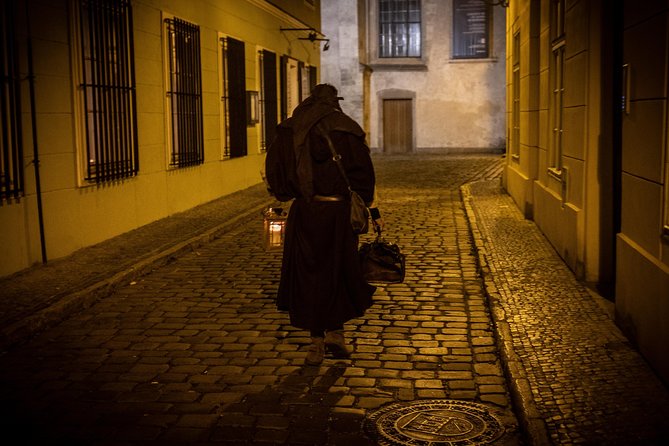
The walk begins at Aurus Hotel Prague on Karlova 3 in the Old Town. The first 10 minutes establish the mood and introduce Alexander Schamsky, the plague doctor connected with the tour’s 1715 setting.
The building itself, known as the House of the Golden Well, gives the opening a sense of place. Rather than beginning with a long lecture, the guide uses the location to explain the religious world surrounding the plague. St. Sebastian and St. Rochus, both associated with protection from the disease, become part of the story.
You also hear about the possible causes people believed in at the time. These beliefs could include religious explanations, moral judgments, bad air, and other ideas that seem strange today but made sense within the medical limits of the period. This is one of the tour’s useful features: it shows how people acted on the information they had, not on what we now know about bacteria and transmission.
The opening stop is short, but it does important work. It tells you how to listen to the rest of the walk. You are not simply looking at old buildings. You are trying to see Prague as a city under fear, confusion, and strict social pressure.
Klementinum, the New Town Hall, and quarantine
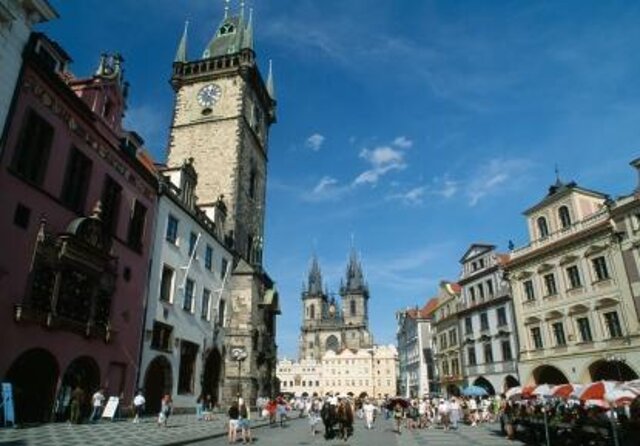
The second stop lasts about 10 minutes and brings in the old monastery Klementinum, its library, and the New Town Hall. The description of this section connects the city’s religious and civic institutions to the plague years.
Here the guide explains different forms of the Black Death and compares how wealthy people and ordinary residents responded. That social contrast is one of the most useful parts of the tour. Wealth could offer better food, more space, and a greater chance of leaving the city, while poorer residents often had fewer choices and more exposure.
Quarantine receives special attention. You get a sense of how isolation affected work, family life, movement, and trust. The subject has obvious modern relevance, but the value is not just in making a comparison with recent events. The tour places quarantine in its own period, when medical theory, government authority, and public fear all operated differently.
The stop also shows why the tour is more than a collection of creepy tales. It connects medical practice to city organization. Monasteries, town halls, libraries, hospitals, markets, and religious sites all become part of the response to disease.
Old Town Square and the merchants of Prague
At Staroměstské náměstí, the large market square, the guide discusses the Hussite Church, Týn Church, and the Old Town Hall. This is one of Prague’s most famous public spaces, so the plague story gains a strong visual setting.
The focus here is on merchants and market life. During an epidemic, trade did not simply stop. People still needed food, supplies, and income, even as markets could also spread illness and bring fear into the center of town. The guide uses this setting to explain the pressure on merchants and the risks faced by people who could not retreat behind private walls.
The tour also reaches back to the Thirty Years’ War. That connection helps place plague within a wider period of upheaval. Disease did not strike a calm, isolated society. War, poverty, population movement, and uncertainty could make outbreaks harder to control.
This stop is a good example of the experience’s mix of sightseeing and storytelling. You see major landmarks, but the emphasis is on how people used the square and how a public market changed under threat. If you mainly want architectural detail, you will get some, but that is not the main purpose here.
Or spend the afternoon on something completely different:
- Prague: Castle Tour with Local Guide and Entry Ticket
★ 4.6 · 10,422 reviews - Prague Castle 2.5-Hour Tour Including Admission Ticket
★ 4.7 · 8,927 reviews - Prague: Oldtown, Medieval Underground & Dungeon History Tour
★ 4.2 · 8,244 reviews - Prague: Vltava River Night Cruise with Buffet
★ 4.3 · 7,338 reviews
Kafka, Jewish Prague, and Albert Camus
The brief stop at the Franz Kafka Statue shifts the story toward Prague’s Jewish community and the wider experience of Jewish people during plague periods in Prague and across Europe.
This is an important part of the walk. Epidemics often create scapegoats, and Jewish communities in Europe faced serious accusations and persecution during plague outbreaks. The tour addresses that social impact rather than speaking only about doctors, saints, and official rules.
The Kafka connection provides a natural doorway into the Jewish Quarter. The guide gives a short introduction to Franz Kafka before moving into the older story of Jewish life and plague-era prejudice. Because the stop lasts only about five minutes, you should not expect a full history of the Jewish Quarter. Instead, it adds a needed human and political layer to the medical story.
The guide also introduces Albert Camus’s novel La Peste. That literary reference links the old plague experience to later ideas about fear, responsibility, isolation, and collective behavior. It is a compact stop, but it helps show how plague remains a subject in European culture long after the original outbreaks.
The old hospital at Na Františku
The Church of Saint Simon and Jude leads into one of the most substantial sections of the tour, about 15 minutes. This is where the medical story becomes more concrete.
The guide introduces the old hospital Na Františku and explains how healing worked before modern treatment. You hear about medical beliefs, practical methods, and the harsh limits faced by doctors and patients. The tour also recognizes lesser-known medical workers who served in the hospital.
That attention to ordinary medical staff is welcome. Plague history can become a parade of famous disasters, but the people caring for the sick often receive little attention. This stop gives you a better idea of the work, risk, and uncertainty involved in treating patients with very limited tools.
The tour places the disease in a worldwide context, including the estimate that plague killed approximately 200 million people worldwide. That figure is enormous, though you should treat the subject as a broad historical overview rather than a lesson in current epidemiology. The guide’s medical background comes through best when explaining how earlier people interpreted symptoms and tried to respond.
If you are interested in public health, medicine, or epidemics, this is likely to be one of your favorite stops. It also helps balance the theatrical costume with real human suffering.
St. Agnes Convent and the final group photograph
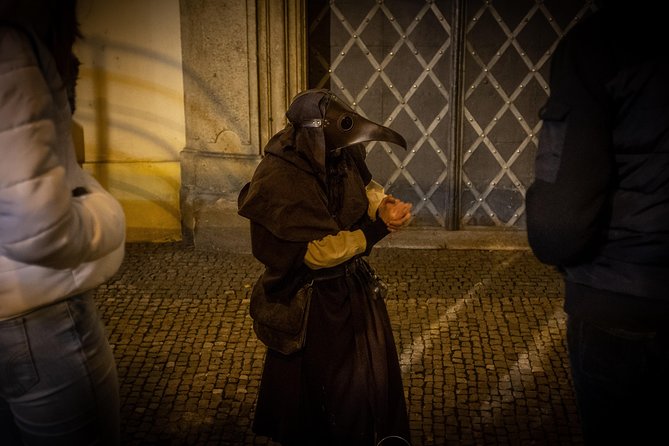
The walk ends at the National Gallery Prague, at the Convent of St. Agnes. This final stop lasts about 15 minutes and introduces St. Agnes of Bohemia, her life, and her work.
The convent gives the ending a quieter tone. After the crowded square, public fear, and hospital material, the guide returns to religion, service, and charity. St. Agnes becomes part of the closing discussion of how Prague and Europe experienced the plague.
The guide then summarizes the main themes and discusses the present status of the disease. This helps connect the historical material to the modern world without making the entire tour about recent pandemics.
A group picture with the plague doctor marks the end. It is a small touch, but it suits the experience. You leave with a memorable image rather than simply walking away from a final speech. The activity ends at a different location from the start, so pay attention to the ending point when planning your evening.
How the guides shape the experience
The guide matters a great deal here. Thomas is repeatedly praised for making people feel as though they have entered the period, while David is credited with careful preparation, clear explanations, and a strong sense of humor. Oscar and Oskar are also described as articulate and engaging, and Maddie receives praise for being well prepared and personal.
The best performance style is playful but not careless. The guide may tell creepy stories, use old medical practices for comic effect, or remain in character as the plague doctor. At the same time, the main subject remains serious.
This approach works especially well for families. One family with children aged 5, 12, and 16 found the experience enjoyable across age groups, and another child aged 10 reportedly made it a favorite activity in Prague. Teens also respond well because the tour feels more active than a museum talk.
There is one practical costume warning. One participant found the outfit smelled and needed refreshing. That is not a major problem for most people, but costumes are part of the experience, so it is worth noting.
Walking effort, timing, and weather
The tour lasts about 1 hour and 30 minutes. The walking is described as manageable, including for people at the end of a long day, and most fitness levels can take part. You will still be moving through city streets, so comfortable shoes are sensible.
The route includes historic squares, alleyways, and the Jewish Quarter. The supplied details do not give a precise distance or a complete step-free route, so contact the provider if you need specific mobility information.
Some people enjoy taking the tour in the evening, when Prague’s streets add atmosphere. Rain can also make the setting feel more dramatic, though poor weather can lead to cancellation. If the provider cancels because of weather or because the minimum group size is not reached, you are offered another date or a full refund.
Free cancellation is available up to 24 hours before the start time. Inside that 24-hour window, you do not receive a refund, and changes are not accepted.
Is $26.61 a fair price?
At $26.61 per person, I consider this a reasonable price for a 90-minute English walking tour with a limited group size and a distinctive subject.
You are not paying for admission to several major attractions. The stops are viewed from the route, and the value comes from the guide’s performance, research, storytelling, and ability to connect the sites. That makes the guide especially important.
I would compare it with the cost of a conventional city walk. This tour covers fewer broad sights, but it gives you a focused theme that can make familiar Old Town locations feel new. The group photograph and costume add entertainment value, while the discussions of quarantine, Jewish history, and medicine add substance.
If your main goal is Prague architecture, another tour may give you more detail. If you want a memorable evening activity that combines the city with public health and social history, the price is easy to justify.
Who should book this tour?
I would recommend it most strongly to:
- People interested in epidemics, medicine, or public health
- Families with children and teenagers who enjoy spooky but educational activities
- Visitors who want an evening walk with a clear theme
- History fans who prefer stories about daily life over a list of dates
- Repeat visitors looking for a different way to see the Old Town
- Anyone who enjoys theatrical guides and a little dark humor
You may want to skip it if you dislike costumed performances, want a purely academic lecture, or have little interest in plague history. The tone is generally fun and approachable, but the subject includes death, fear, quarantine, and persecution.
Should you book The Plague Doctor of Prague?
Yes, if you want an unusual and well-priced way to explore central Prague. The tour’s best qualities are its small advertised group size, strong guides, manageable walking route, and willingness to discuss social effects alongside medical facts.
Book it for the experience of seeing Prague through a specific historical crisis, not for a complete guide to every landmark. Choose it especially if your group includes teens, medical professionals, history fans, or anyone who likes a little wholesome dark fun. Just allow for the possibility that the performance may sometimes feel stronger than the historical detail, and remember that the ending is at a different place from the start.
FAQ
How long does The Plague Doctor of Prague last?
The tour lasts approximately 1 hour and 30 minutes.
Where does the tour begin?
It begins at Aurus Hotel Prague, Karlova 3, 110 00 Praha 1-Staré Město, Czechia.
Where does the tour end?
The activity ends at a different location from the starting point, at the National Gallery Prague, Convent of St. Agnes.
What language is the tour offered in?
The tour is offered in English.
How much does the tour cost?
The listed price is $26.61 per person.
How many people can join the tour?
The advertised maximum is 10 travelers.
Is the tour suitable for most fitness levels?
Yes. Most travelers can participate, and the walking is described as manageable. Service animals are also allowed.
Can I cancel for a refund?
You can cancel up to 24 hours before the start time for a full refund. Cancellations or changes made less than 24 hours before the start time are not refunded or accepted.
Newest listings in Prague
- World War II 4WD Tour from Prague with Lunch★ 4.4 · 3 reviews
- Prague: Historical Walking Tour with Focus on World War 2★ 4.3 · 12 reviews
- WWII and Communism History in Prague’s Old Town Private Tour★ 5.0 · 4 reviews
- Wroclaw: Giant Mountains & Valley of Palaces Day Tour★ 4.8 · 36 reviews
- Walking tour of Prague in French : Nové Město★ 4.9 · 16 reviews
- Walking tour of Prague in french: Old Town & Charles Bridge★ 4.9 · 62 reviews
- Vltava River Cruise and Private Tour of Prague’ Old Town★ 5.0 · 1 review
- Ultimate Unlimited Beer Pong with Czech Beer★ 4.6 · 5 reviews
Prague Tours, compared.
Castle Tour with Local Guide and Entry Ticket
Read our review →
Prague Castle 2.5-Hour Tour Including Admission Ticket
Read our review →
Oldtown, Medieval Underground & Dungeon History Tour
Read our review →