
REVIEW · WALKING TOURS
Private Prague Art Nouveau and Cubism Walking Tour
Prague has a modernist side worth hunting down. This private tour links grand Art Nouveau interiors, playful Cubist buildings, and streets you could easily pass without noticing. I especially like the small private group, capped at 15, and the way guide Max Hutar helps you recognize these styles across the city. The $94.93 group price can also be strong value if several people share it.
The main consideration is the pace. You walk between many stops, use public transportation during part of the route, and the tour can run beyond its advertised two hours and 30 minutes. Some sites have admission charges not included, so this is best for visitors who want an architecture lesson in the streets rather than a slow indoor museum visit.
In This Review
- Key points to know before booking
- Why Prague Art Nouveau and Cubism deserve your attention
- Starting inside Prague Main Station
- Moorish color at Jerusalem Synagogue
- Senovážné Square and Hotel Central
- Municipal House, Prague’s grand Art Nouveau showpiece
- House of the Black Madonna and Prague Cubism
- Na Příkopě and the Cubist lamppost
- Wenceslas Square and Vodičkova
- Three Cubist Houses beneath Vyšehrad
- Villa Kovařovic and the final Cubist streets
- Walking time, public transport, and the route’s physical demands
- Is $94.93 a fair price?
- Who will enjoy this private walk?
- The guide makes the difference
- Should you book Prague Art Nouveau and Cubism?
- FAQ
- Where does the Prague Art Nouveau and Cubism tour begin?
- Where does the tour end?
- How long does the tour last?
- Is the tour private?
- What language is offered?
- Is public transportation used?
- Are admission fees included?
- Can most people participate?
- What is the cancellation policy?
Key points to know before booking
- Thirteen carefully chosen stops: The route moves from Prague’s Central Station to the Albertov tram area, covering major Art Nouveau and Cubist landmarks.
- A private tour for up to 15 people: Your group receives direct attention from Max Hutar, rather than joining a large general sightseeing walk.
- Art Nouveau and Cubism side by side: You see the flowing decoration of Art Nouveau, then the sharp angles and geometric experiments of Prague Cubism.
- A useful orientation to central Prague: The route passes through New Town, Old Town’s edge, Wenceslas Square, and streets near Vyšehrad.
- Expect real walking and public transport: The stop times add up to less than the total tour length because of walking between buildings and a transit leg.
- Strong praise for the guide’s storytelling: The highest marks focus on Max’s enthusiasm, preparation, clear explanations, and ability to make architecture approachable.
Why Prague Art Nouveau and Cubism deserve your attention
Prague is famous for its medieval lanes, Baroque churches, and castle views. Yet the city also became an exciting center for modern design around the turn of the 20th century. This tour focuses on that less obvious layer.
Art Nouveau favors curves, plant forms, decorative facades, stained glass, and carefully designed interiors. Prague’s version can feel grand and theatrical, especially in public buildings and hotels. Cubism is harder to define at first glance. Here, architects turned to sharp planes, triangular shapes, and faceted surfaces, applying ideas from painting to buildings and even street furniture.
I like the route because it does not treat these movements as isolated museum pieces. You see them in stations, apartment blocks, banks, department stores, a synagogue, a hotel, and a lamppost. By the end, you should have a better eye for details elsewhere in Prague.
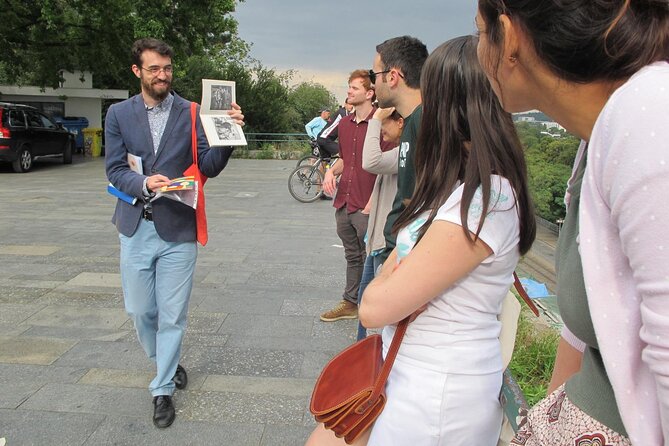
The private format matters. Max Hutar, the guide behind Prague Articulate, has been praised for making technical material lively and for connecting design to the people and debates of the period. You are not simply handed dates and names. The goal is to notice how a building works, why its shape looks unusual, and what made the style exciting or controversial.
More Walking Tours in Prague:
- Prague: 3-Hour Walking Tour of Old Town & Prague Castle
★ 4.7 · 5,696 reviews - Prague: Ghost Walking Tour Where Legends Come To Life
★ 4.4 · 5,253 reviews - Prague: Jewish Quarter Walking Tour with Admission Tickets
★ 4.7 · 3,729 reviews
Starting inside Prague Main Station
The tour begins at Prague Main Station, at Wilsonova 300/8. The station’s historic building opened in 1909 and offers a strong first lesson in local Art Nouveau.
You spend about 15 minutes here, looking at the halls and corridors. The building has recently been reconstructed, so this opening stop gives you a chance to see decorative architecture in a setting that is still part of daily city life.
This is a smart starting point. You can arrive by train, and the station is easy to reach by public transportation. It also gives the tour an immediate sense of scale. Art Nouveau was not only used for private homes or small decorative objects. It could shape major civic spaces.
The admission cost for this stop is free. Bring your phone or camera, but listen carefully too. The value here comes from understanding what to look for, not simply taking a few grand interior pictures.
Moorish color at Jerusalem Synagogue
The next stop is Jerusalem Synagogue, built in 1906. Its main design follows a Moorish tradition associated with synagogue architecture, while also incorporating Art Nouveau details.
You spend about five minutes here. That sounds brief, but this is an exterior-focused stop in a route with many buildings to cover. Admission is not included, so check the arrangements for entering if that is part of your visit.
This building helps prevent an overly narrow view of Art Nouveau. The style did not erase older traditions. Instead, architects mixed contemporary decoration with Moorish, Gothic, Baroque, and other references. Jerusalem Synagogue is useful precisely because it does not fit into a single tidy box.
Senovážné Square and Hotel Central
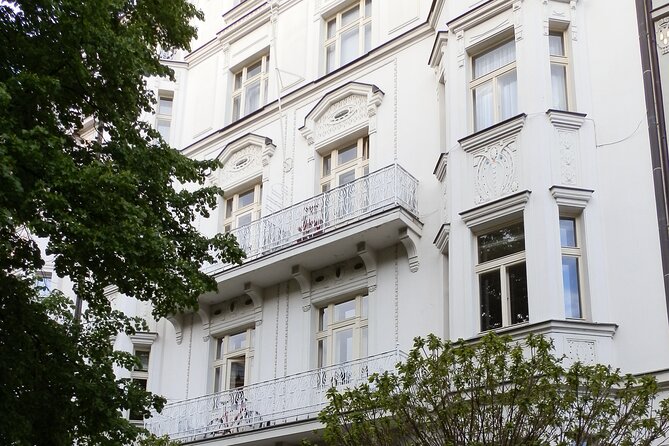
At Senovážné Square, you see three luxurious apartment buildings from the Art Nouveau period. The stop lasts about five minutes and is free.
Apartment buildings are important here because they show how artistic ideas reached ordinary urban streets, even when the buildings were designed for affluent residents. Look for repeated decorative features across the facades and compare the buildings rather than treating each one as a separate photograph.
The route then continues to Hotel Central on Hybernská 10. Built in 1899, it is among Prague’s earliest Art Nouveau buildings. The tour allows about five minutes here, and admission is not included.
This building gives you a useful before-and-after comparison. Early Art Nouveau can feel less settled than later examples. Architects were testing new decoration and new ways to break away from older historic styles. Hotel Central helps place the later Municipal House and other grand works in a sequence.
A few more Prague options to compare
- Prague: 50-Minute Sightseeing Evening Cruise
★ 4.2 · 33,780 reviews - Prague: Medieval Dinner with Unlimited Drinks
★ 4.4 · 19,847 reviews - Prague: Skip-the-line Castle Ticket and Optional AudioGuide
★ 4.3 · 11,121 reviews - Prague: Castle Tour with Local Guide and Entry Ticket
★ 4.6 · 10,422 reviews
Municipal House, Prague’s grand Art Nouveau showpiece
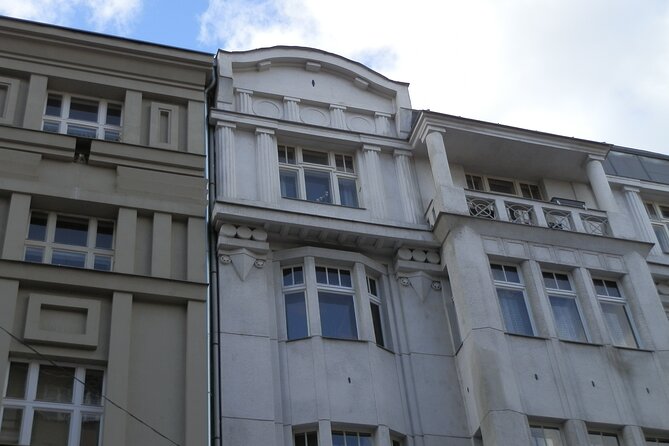
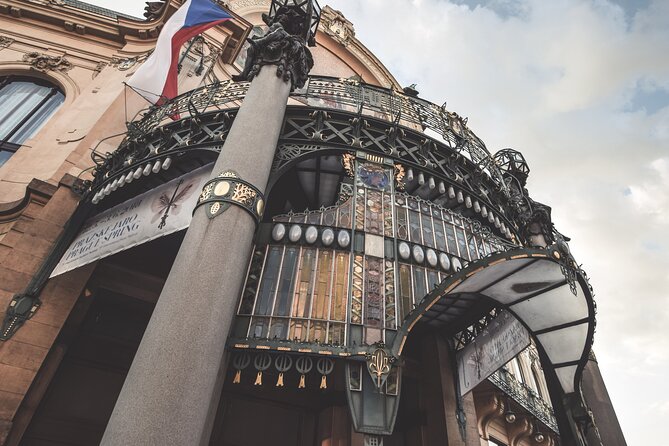
Obecní Dům, or the Municipal House, is one of the major highlights. Projected in 1905, it still serves as a cultural and representative building for Prague.
The tour allows about 10 minutes here. Admission is not included, so do not assume the walk automatically includes a full interior visit. Even with limited time, the building is important because it brings together architecture, decoration, and civic purpose on a large scale.
This is the point where Art Nouveau becomes especially theatrical. The Municipal House was intended to represent Prague, not merely provide offices or apartments. Its design makes a public statement through ornament and ceremony.
I would pay close attention to how the building fits into the route. After smaller examples at the station, square, hotel, and synagogue, this is a major expression of the same period. Max’s explanations are particularly useful here because the building can otherwise become just another ornate photo stop.
House of the Black Madonna and Prague Cubism
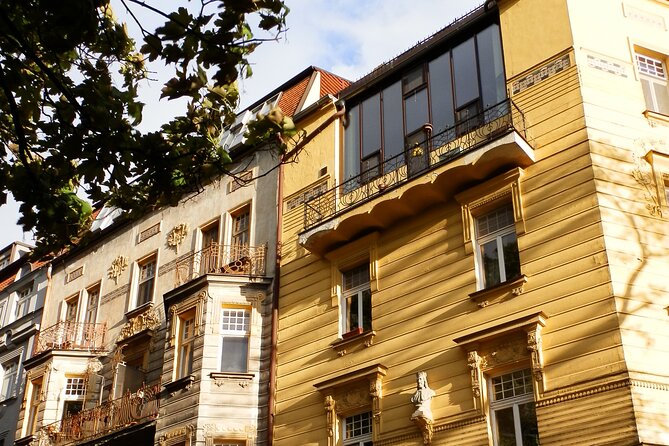
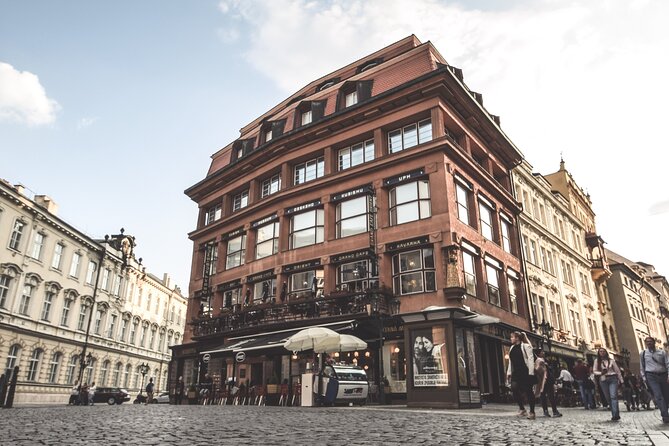
The House of the Black Madonna, built in 1912, marks the tour’s shift toward Cubism. Its central location and stylistic purity make it one of Prague’s most important Cubist buildings.
The stop lasts about 10 minutes, and admission is not included. The building is known for its strong geometric character, making it a good place to test your new visual vocabulary. Instead of searching for soft curves and floral decoration, look for angular forms, faceted surfaces, and a sense that the facade has been folded or cut.
Prague’s Cubism is one reason this tour feels different from a standard city walk. Cubism is often introduced through paintings, but Prague architects adapted its ideas to buildings. The House of the Black Madonna is the clearest early example on this route.
Na Příkopě and the Cubist lamppost
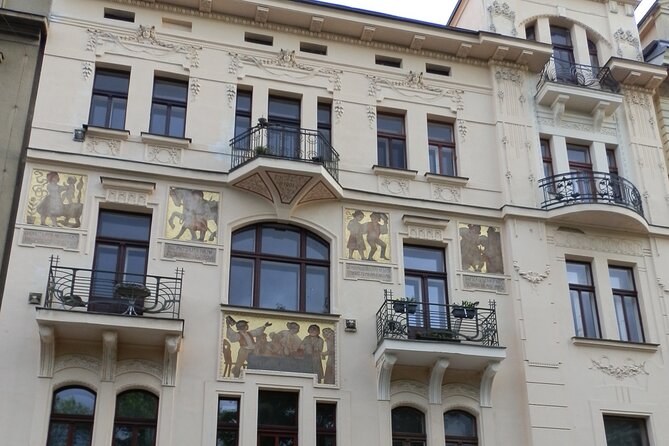
Na Příkopě forms a boundary between Prague’s Old Town and New Town. Its banks and commercial buildings provide more Art Nouveau examples, with about five minutes allowed for the stop.
This is a useful urban comparison. You are not looking at one isolated landmark. You are seeing how decorative design appeared along a major commercial boulevard, where financial and business buildings needed to look solid, modern, and important.
Then comes Emil Králíček’s Cubist lamppost, one of the route’s most unusual stops. The tour calls it a radical piece of street furniture, and that is exactly why it deserves attention. A lamppost may sound minor beside a grand building, but this object shows how Cubist ideas could reach the street itself.
The stop is free and lasts about five minutes. You might otherwise walk past it without a second thought. This is one of the tour’s best reminders to keep looking down, up, and around you.
Wenceslas Square and Vodičkova
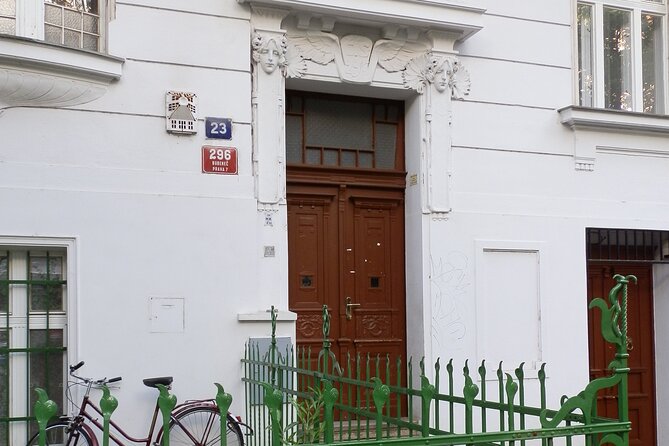
Wenceslas Square receives about 20 minutes, the longest stop on the route. This central downtown space includes Art Nouveau hotels and department stores.
The square is broad, busy, and easy to recognize, but the tour gives you a reason to study its edges. The buildings show how commercial Prague used decoration to signal quality and ambition. Hotels and department stores were competing for attention, so their facades often became advertisements in stone and plaster.
Vodičkova follows with about 10 minutes. Several striking Art Nouveau and Cubist buildings are located along this street.
These two stops work well together. Wenceslas Square gives you a large civic and commercial setting, while Vodičkova offers a more concentrated street study. You can compare softer Art Nouveau decoration with the harder geometry of Cubism without needing a classroom or museum display.
Three Cubist Houses beneath Vyšehrad
The route then moves toward the Three Cubist Houses, a famous group of buildings beneath the Vyšehrad fortress. The stop lasts about five minutes, and admission is not included.
The three houses are valuable because they show Cubism as a group composition rather than a single facade. Their shapes and angles create a stronger visual effect when viewed together. You can see how an architectural style changes the feeling of a whole section of street.
This part of the tour also broadens your sense of Prague’s geography. You are moving beyond the most obvious central sights toward the area near the Vltava and Vyšehrad. The route is not just a loop around Old Town Square. It connects several districts through a subject that gives the journey a clear purpose.
Villa Kovařovic and the final Cubist streets
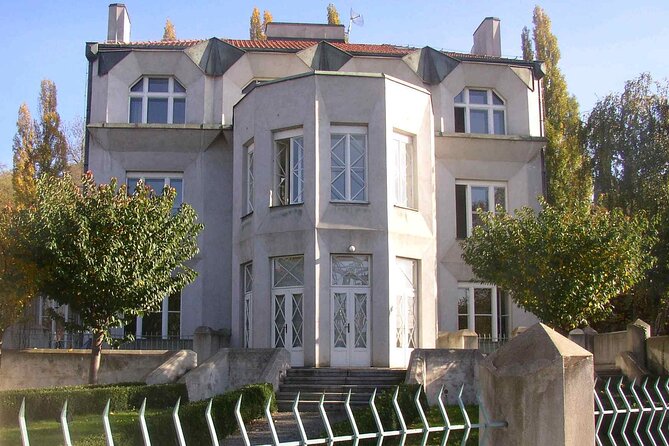
Villa Kovařovic, built beside the Vltava in 1912, is another Cubist highlight. Its design draws on Gothic and Baroque architecture while using the angular language of Cubism.
The tour allows about 10 minutes here, with admission not included. This building is a good example of how architects could look backward and forward at the same time. Cubism did not require a complete rejection of older forms. It could reshape familiar references into something strikingly new.
The last stop is Neklanova, where an impressive Cubist apartment building from 1913 brings the architectural portion to a close. The stop lasts about five minutes and is free.
Ending with an apartment building makes sense. The tour has moved through major public buildings, commercial streets, and famous Cubist landmarks. Neklanova returns the focus to urban residential architecture and shows how experimental design could become part of everyday city life.
Walking time, public transport, and the route’s physical demands
The stop times total less than two hours and 30 minutes because the tour includes walking between locations and a public transportation segment. That detail matters. You are not standing in one place for the full duration.
One participant specifically found that the walking involved and that the tour could run longer than 2.5 hours. Plan your schedule with a little breathing room afterward, especially if you have a train, dinner reservation, or another timed visit.
The route starts at Prague Main Station and finishes near Albertov tram stop, at Na Slupi 2102/2b. The same public transportation ticket used for the last leg remains valid long enough to get you back toward the city center.
Most people can take part, and the tour is near public transportation. Service animals are allowed. Still, you should be comfortable walking through central streets and changing locations several times. Comfortable shoes will make the experience easier, even though that simple advice is not printed on the ticket.
Is $94.93 a fair price?
The price is $94.93 per group for up to 15 people. That is not a per-person rate, so the value changes greatly with group size.
For one or two people, it is a fairly substantial private-tour cost. You are paying for a focused subject, a private guide, and a route that would be difficult to recreate efficiently on your own. For a family or group of friends, the cost becomes more attractive when divided among several people.
There are no separate admission fees included for several stops, including Jerusalem Synagogue, Hotel Central, the Municipal House, the House of the Black Madonna, the Three Cubist Houses, and Villa Kovařovic. The tour may view some sites from outside, but you should confirm what can be entered when booking and budget for any optional admissions.
The value is strongest if you care about design and want context. If you only want a quick introduction to Prague’s most famous monuments, a general city tour may serve you better.
Who will enjoy this private walk?
I would recommend it first to architecture, design, photography, and urban-history fans. You do not need prior training. Several people began with little knowledge of Art Nouveau and Cubism and finished able to identify examples elsewhere in Prague.
The tour also suits repeat visitors who have already seen Prague Castle, Charles Bridge, and the Old Town core. It offers a fresh way to read streets you might otherwise treat as background scenery.
Families and small groups may appreciate the private format, especially because Max has been praised for accommodating different needs. It also works well for visitors attending a conference or taking a short city break, provided they leave extra time around the scheduled finish.
I would be more cautious if you dislike walking, want a long indoor visit at every stop, or prefer a tightly timed tour. The route covers a lot, and the guide’s enthusiasm may keep the conversation going beyond the advertised length.
The guide makes the difference
The strongest praise centers on Max Hutar. He is described as passionate, engaging, well-prepared, and able to connect architectural styles with human stories and the controversies of the period.
That combination is important. Art Nouveau can become a blur of pretty facades, while Cubism can seem cold or difficult. A good explanation gives each style a purpose and helps you see why architects made these choices.
Max also appears to adjust to the group. One person noted that he was accommodating, and another praised the way he made a specialized subject feel like an enjoyable lesson rather than a lecture. The tour has received eight top ratings, with repeated approval for its unusual perspective and clear storytelling.
The only practical caution is that enthusiasm can affect timing. If you want the full benefit of the tour, do not plan a tight appointment immediately afterward.
Should you book Prague Art Nouveau and Cubism?
Book it if you want to understand Prague beyond its postcard center. The route combines major buildings with small surprises, including Emil Králíček’s Cubist lamppost, and it teaches you how to spot these styles on your own.
The best deal comes when several people share the $94.93 group price. Confirm the admission arrangements, wear comfortable shoes, and allow more than two and a half hours if your schedule is tight.
I would skip it only if your priority is a broad overview of Prague’s main sights or a relaxed indoor tour. For anyone curious about architecture and willing to walk, this is a focused, memorable way to see the city from a different angle.
FAQ
Where does the Prague Art Nouveau and Cubism tour begin?
It begins at Prague Main Station, at Wilsonova 300/8 in Prague 2.
Where does the tour end?
It concludes near the Albertov tram stop, at Na Slupi 2102/2b in Prague 2.
How long does the tour last?
The advertised duration is approximately two hours and 30 minutes.
Is the tour private?
Yes. Only your group participates, with a maximum group size of 15 people.
What language is offered?
The tour is offered in English.
Is public transportation used?
Yes. Public transportation is used during part of the route, and the ticket used for the final leg remains valid long enough to return toward the city center.
Are admission fees included?
The itinerary lists some admissions as not included, including Jerusalem Synagogue, Hotel Central, the Municipal House, the House of the Black Madonna, the Three Cubist Houses, and Villa Kovařovic. Other listed stops are free.
Can most people participate?
Yes. Most people can participate, the tour is near public transportation, and service animals are allowed.
What is the cancellation policy?
You can cancel at least 24 hours before the local start time for a full refund. Cancellations or changes made less than 24 hours before the start are not accepted for a refund.
Newest listings in Prague
- World War II 4WD Tour from Prague with Lunch★ 4.4 · 3 reviews
- Prague: Historical Walking Tour with Focus on World War 2★ 4.3 · 12 reviews
- WWII and Communism History in Prague’s Old Town Private Tour★ 5.0 · 4 reviews
- Wroclaw: Giant Mountains & Valley of Palaces Day Tour★ 4.8 · 36 reviews
- Walking tour of Prague in French : Nové Město★ 4.9 · 16 reviews
- Walking tour of Prague in french: Old Town & Charles Bridge★ 4.9 · 62 reviews
- Vltava River Cruise and Private Tour of Prague’ Old Town★ 5.0 · 1 review
- Ultimate Unlimited Beer Pong with Czech Beer★ 4.6 · 5 reviews
Walking Tours, compared.
3-Hour Walking Tour of Old Town & Prague Castle
Read our review →
Ghost Walking Tour Where Legends Come To Life
Read our review →
Jewish Quarter Walking Tour with Admission Tickets
Read our review →
Prague Guided Walking Tour and Cruise with Authentic Czech Lunch
Read our review →
Old Town and Jewish Quarter Guided Walking Tour
Read our review →
Prague Ghost and Legend of Old Town Walking Tour
Read our review →
Prague 3-hour Afternoon Walking Tour including Prague Castle
Read our review →
Ghosts and Legends Nighttime Guided Walking Tour
Read our review →Browse the lists this tour appears in