
REVIEW · JEWISH QUARTER TOURS
Prague: Jewish Quarter Premium Tour
Prague’s Jewish Quarter rewards a slower pace. This three-hour walk brings you into four historic synagogues, the Old Jewish Cemetery, and the Chevrah Kaddisha ceremonial hall, with a guide to explain what you are seeing. I like the clear focus on Czech Jewish life and the way the route connects religious practice, daily life, and the Holocaust. I also like that the tour includes four synagogue interiors rather than only a quick look from the street.
The most moving stop is the Pinkas Synagogue, where the names and stories of Czech Holocaust victims give the history a human scale. The children’s drawings from the Terezin Ghetto are hard to view, but they are an important part of the visit. The main caution is pace: one June participant found the walk rushed, with crowds making it difficult to hear and keep up.
In This Review
- Key points to know before booking
- A serious introduction at the Old-New Synagogue
- Pinkas Synagogue and the children of Terezin
- The Old Jewish Cemetery and its layers of graves
- The Chevrah Kaddisha ceremonial hall
- Klausen Synagogue and everyday Jewish practice
- Maisel Synagogue and the longer Prague story
- Spanish Synagogue, the visual finale
- What the guide and group size mean
- Is $117 good value for three hours?
- Practical advice for a better visit
- Who should book this Jewish Quarter tour?
- FAQ
- How long is the Jewish Quarter tour?
- Which synagogues are included?
- Can I enter the Old-New Synagogue on this tour?
- What can I see at Pinkas Synagogue?
- Does the tour visit the Old Jewish Cemetery?
- What languages are available?
- Does the tour operate on Saturdays?
- Should you book it?
Key points to know before booking
- Four synagogue interiors included: Pinkas, Klausen, Maisel, and the Spanish Synagogue are covered by the admission.
- The Old-New Synagogue is viewed from outside: Entry is not included in the $117 price.
- The Holocaust section is emotionally serious: Pinkas Synagogue and the Terezin children’s drawings require time and quiet attention.
- The Old Jewish Cemetery is unusually dense: Graves can be layered as many as 12 levels deep.
- The guide makes a major difference: Guides such as Donna, Clara, and Valentina received especially warm praise for clear, thoughtful explanations.
- Saturday is not available: The Jewish Museum is closed, so plan for another day.
A serious introduction at the Old-New Synagogue
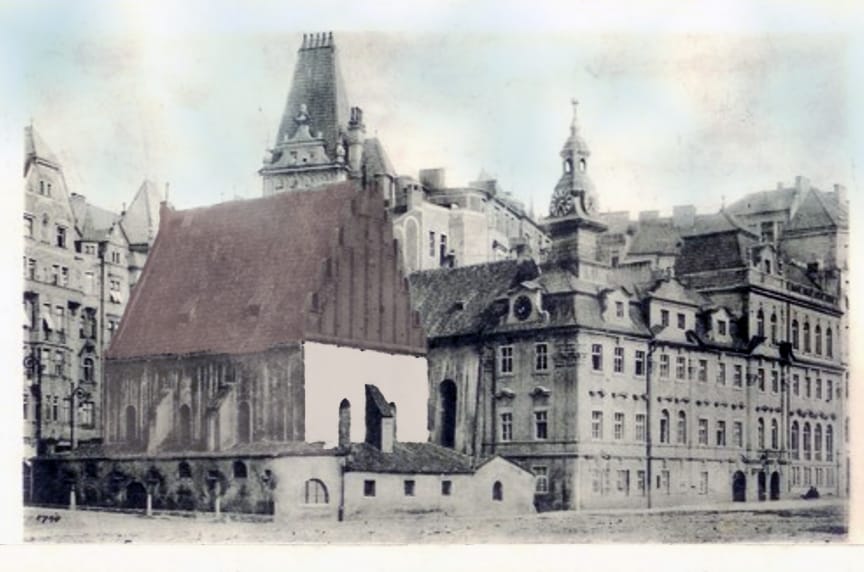
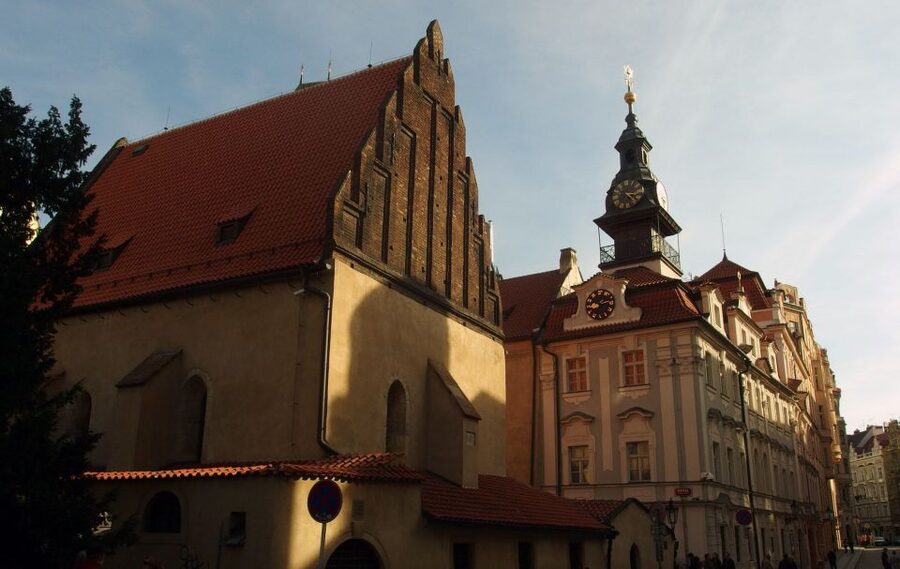
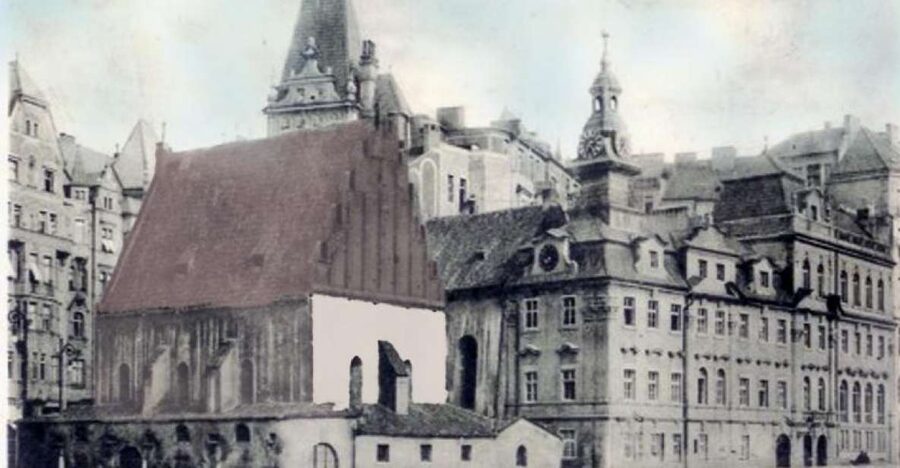
Meet at Golem Café in the Information Centre of the Jewish Museum, in central Prague. From there, the walking route begins with the exterior of the 13th-century Old-New Synagogue, one of the oldest active synagogues in Europe and often described as the oldest north of the Alps.
You do not enter this building on the tour. That detail matters because admission to the Old-New Synagogue is not part of the package. You can admire its exterior and hear about its place in Prague’s Jewish story, but you should not expect a guided visit inside.
Even from outside, the synagogue gives the opening of the tour a strong sense of place. It is not simply another old building in the center of Prague. It remains an active place of worship, which helps you understand that the Jewish Quarter is not only a museum district. It is also a place connected to living religious practice.
Your guide sets the broad historical frame here. The route then moves from the medieval and religious past toward the destruction of Czech Jewish communities during the Second World War. That shift is one of the tour’s strengths, though you will want to listen closely because several major subjects are covered in only three hours.
More Jewish Quarter walks:
- Prague: Jewish Quarter Walking Tour with Admission Tickets
★ 4.7 · 3,729 reviews - Prague: Old Town and Jewish Quarter Guided Tour in German
★ 4.8 · 3,143 reviews - Prague: Old Town and Jewish Quarter Guided Walking Tour
★ 4.6 · 2,847 reviews
Pinkas Synagogue and the children of Terezin
Pinkas Synagogue is likely to be the emotional center of your visit. It functions as a memorial museum dedicated to Czech Jewish victims of the Holocaust, and its purpose changes the way you experience the building. This is not simply an attractive historic interior. It is a place of names, absence, and remembrance.
The exhibition of drawings by children from the Terezin Ghetto is especially painful. The drawings offer a child’s view of confinement, fear, and daily life under Nazi persecution. Their directness can affect younger visitors as well as adults, so I would prepare children in advance rather than treating this as a light sightseeing stop.
The tour is suitable for families who are ready for serious subject matter. One parent described the visit as very meaningful with an 11-year-old son, while another participant praised the guide’s sensitive handling of the material. That balance matters. A good explanation can help you understand the historical setting without turning suffering into a spectacle.
Give yourself a moment to look before moving on. The guide may need to keep the group together, especially when the museum is busy, but this is one place where rushing works against the subject. If you have a particular interest in the Holocaust, you may want to return later for a longer, quieter visit.
The Old Jewish Cemetery and its layers of graves
The Old Jewish Cemetery is one of Prague’s most striking historic sites. Graves are packed tightly together, with some layers reaching as many as 12 levels deep. The crowded arrangement reflects the limited space available for burial and the long span of time represented in this small area.
You will not see a neat grid of individual graves with broad paths between them. Instead, the site feels compressed, with tilted stones and overlapping layers showing how generations were buried in the same ground. Your guide’s explanation is important because the physical arrangement can seem confusing without context.
This stop also gives the tour a useful pause between the memorial displays and the synagogue collections. You are looking at a burial ground, but you are also reading a record of communal life through names, dates, and symbols carved into stone.
The cemetery can be crowded, and the walking surfaces may make comfortable shoes especially useful. Dress for the weather, since this is a walking tour and some of your time is spent outdoors. I would not choose delicate footwear for this route, nor would I plan a tight appointment immediately afterward.
The Chevrah Kaddisha ceremonial hall
The tour also includes the Ceremonial Hall of the Prague Burial Society, part of the Chevrah Kaddisha building. This stop broadens the story beyond famous rabbis and grand architecture by showing how Jewish communities cared for the dead and organized important religious duties.
That subject may sound less familiar than a synagogue visit, but it gives the cemetery more meaning. Jewish communal life involved institutions for worship, education, burial, charity, and family rituals. The ceremonial hall helps you see that the Jewish Quarter was once a working community, not just a collection of monuments preserved for sightseeing.
It is also a good example of why a guided walk can be more useful than visiting the buildings alone. Without an explanation, you might admire the architecture and move on. With context, the hall becomes part of a larger picture of communal responsibility and religious custom.
A few more Prague options to compare
- Prague: 50-Minute Sightseeing Evening Cruise
★ 4.2 · 33,780 reviews - Prague: Medieval Dinner with Unlimited Drinks
★ 4.4 · 19,847 reviews - Prague: Skip-the-line Castle Ticket and Optional AudioGuide
★ 4.3 · 11,121 reviews - Prague: Castle Tour with Local Guide and Entry Ticket
★ 4.6 · 10,422 reviews
Klausen Synagogue and everyday Jewish practice
Klausen Synagogue focuses on Jewish traditions, rituals, and daily life. It also includes material connected with the Maharal of Prague, the famous rabbi associated with the city’s Jewish past.
This stop helps balance Pinkas Synagogue’s Holocaust memorial role. You see objects and information linked to how people lived, worshipped, marked important occasions, and maintained their community. That balance is important because a visit to the Jewish Quarter should not reduce Jewish history to persecution alone.
The Klausen collection may appeal most to you if you want practical cultural context. Religious objects can be difficult to interpret without guidance, particularly if you are unfamiliar with Jewish customs. The live guide can explain what the objects were used for and why they mattered.
The quality of that explanation is central. Several people praised guides for answering questions patiently and explaining Judaism as well as local history. Valentina, Donna, and Clara were singled out for their strong presentations, while another guide was praised for being especially thorough and well grounded in history.
Maisel Synagogue and the longer Prague story
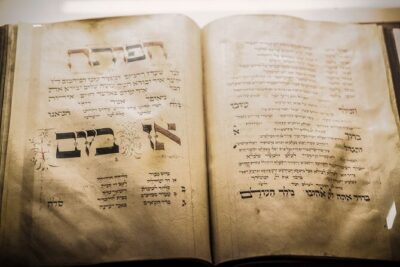
Maisel Synagogue contains a large collection of Judaica and continues the tour’s explanation of Jewish life in Prague. After the emotional force of Pinkas and the solemnity of the cemetery, this stop gives you more material to examine and more time to consider the community’s traditions.
I like the way Maisel fits into the route because it prevents the experience from becoming only a memorial tour. You learn about objects, customs, and the development of Jewish life in the Czech lands. The collection also gives your guide plenty of material for questions, though the amount of information can feel heavy if you prefer a short architectural tour.
You should listen for the connections between the objects and the places you have already seen. The cemetery, ceremonial hall, and synagogues are not separate attractions. Together, they show the structure of a community and the scale of what was lost.
If you have only a passing interest in history, the amount of information may be demanding. If you enjoy cultural detail, this is one of the strongest parts of the route. A participant who joined the tour with a young son found the visit interesting, and another described the experience as useful for understanding Jewish life in Prague and across Europe.
Spanish Synagogue, the visual finale
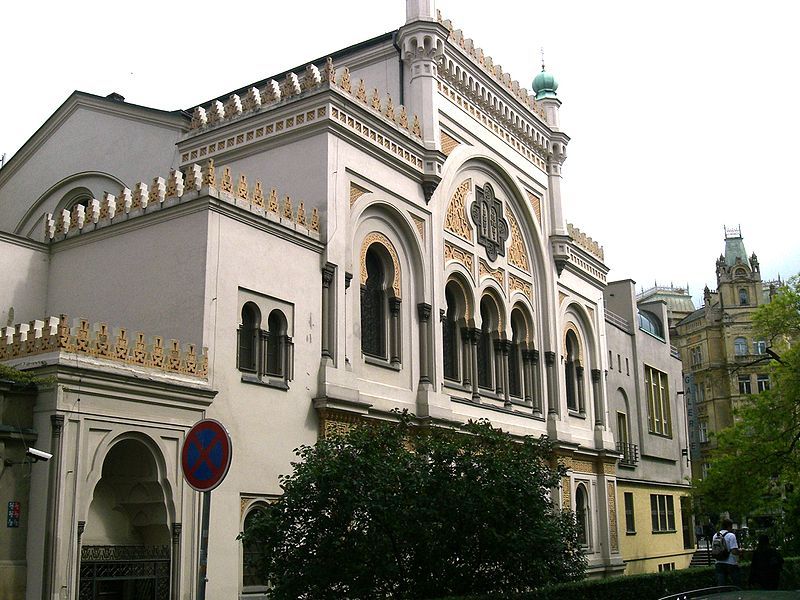
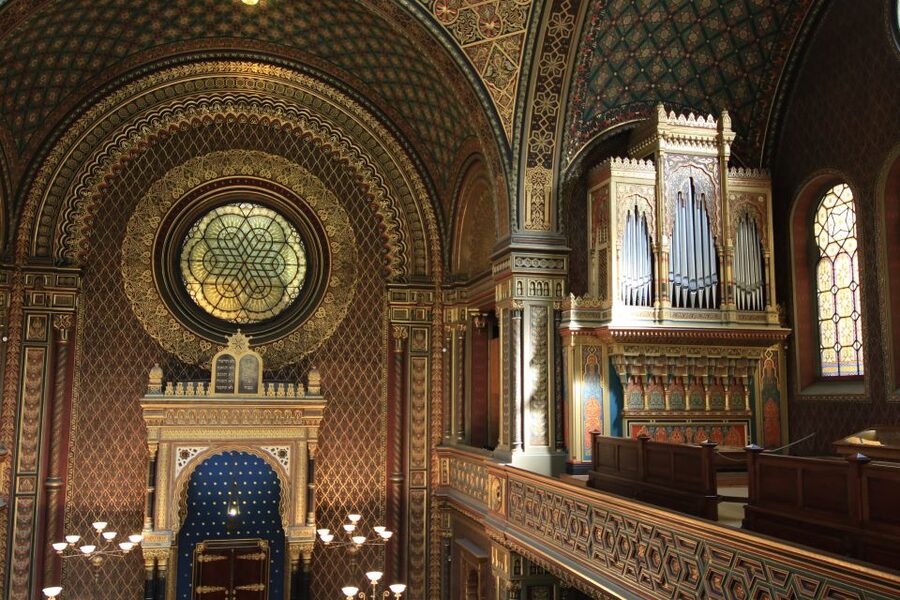
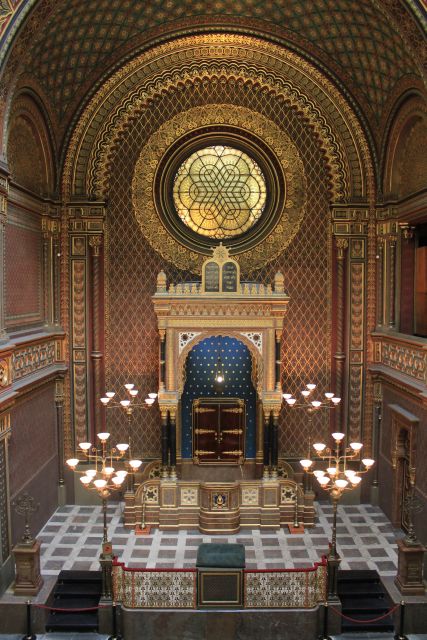
The Spanish Synagogue is the most decorative stop on the route and provides a striking final image. Its Moorish-inspired design gives it a different look from the other buildings, and the recently restored interior adds visual appeal to the closing part of the tour.
After the sober memorials, the synagogue’s ornament can feel like a change of mood. Do not mistake the beauty for a simple finale, though. The building still belongs to the same complicated story of Jewish life, worship, cultural achievement, and loss in Prague.
This is the stop most likely to attract your camera, but photography should not distract from the guide’s final explanations. Listen for how the Spanish Synagogue fits into the broader Jewish Quarter rather than treating it as an isolated architectural curiosity.
The route’s progression works well: medieval religious life, Holocaust remembrance, burial customs, everyday practice, Judaica, and finally an ornate synagogue. You get a broad introduction in a limited amount of time, though you will need to accept that no single stop receives unlimited attention.
What the guide and group size mean
A live guide leads in Czech or English. An audio guide is also included in German, French, Hebrew, Spanish, Portuguese, Polish, Dutch, Italian, Chinese, Czech, and Russian. Confirm the language arrangement when booking, especially if you need a specific language for the live commentary.
One person booked a Hebrew tour but received an English-speaking guide, which was disappointing despite an otherwise excellent experience. The practical lesson is simple: do not assume that an available audio language means the live guide will speak that language.
Guide quality appears to be one of the tour’s biggest strengths. Valentina was praised for patience and broad knowledge of Jewish history and Judaism. Donna was described as especially enthusiastic, while Clara was praised for her clear information. One guide was the son of a couple who had met in a concentration camp, survived, and married after the war. That personal connection gave the tour an unusual human dimension, though you should not expect every guide to bring the same family story.
Group size can also affect the experience. One small group had only seven people, making it easy to hear the guide and ask questions. A larger or crowded departure may feel different. One June participant found the guide walking too quickly and sometimes difficult to hear. If you struggle with fast walking or hearing in busy spaces, stay near the guide at the start and speak up promptly if you fall behind.
Is $117 good value for three hours?
The price is $117 per person, which is not cheap for a three-hour walking tour. The value depends on how much structure and explanation you want.
The fee includes admission to Pinkas, Klausen, Maisel, and the Spanish Synagogue. You also visit the cemetery, ceremonial hall, and Old-New Synagogue exterior. If you visited the buildings independently, you might save money, but you would also need to organize the sequence and supply your own historical context.
I think the price is easier to justify if this is your first visit to Prague’s Jewish Quarter. The sites are close together, but their meaning is not always obvious. A guide can explain why the cemetery is layered, how burial societies worked, what the ritual objects represent, and why Pinkas Synagogue is devoted to Holocaust remembrance.
The value is weaker if you want a slow museum visit. Three hours is enough for an overview, not for reading every display or lingering in each interior. You may leave with a clear framework and still want to return to one or two buildings on your own.
The tour allows cancellation up to 24 hours in advance for a full refund, and you can reserve now and pay later. Those terms are useful if your Prague schedule is still changing, but the main decision remains the same: pay for interpretation and convenience, not merely entry tickets.
Practical advice for a better visit
Wear comfortable shoes and dress for the weather. The route is on foot, and the cemetery and outdoor sections make conditions matter.
Do not schedule the tour on Saturday. The Jewish Museum is closed that day, so the tour does not operate.
Allow emotional space after Pinkas Synagogue. You may want a quiet break rather than another major attraction immediately afterward, particularly if the Terezin drawings affect you strongly.
Arrive at Golem Café in the Information Centre of the Jewish Museum with enough time to find the meeting point. One participant reported confusion about the booking on arrival, although the tour itself went well afterward. Keep your booking details available and clarify the guide language before the walk begins.
If you want to ask questions, a smaller departure will help, but group size is not guaranteed in the supplied information. Stay close to the guide in crowded areas. The June experience shows how quickly a busy route can become hard to follow.
Who should book this Jewish Quarter tour?
I would recommend it to you if you want a focused introduction to Prague’s Jewish history, prefer learning from a live guide, and are comfortable with Holocaust-related material. It suits first-time visitors who want the main Jewish Museum sites arranged into a logical walk.
Families can consider it, but parents should explain that Pinkas Synagogue includes painful Holocaust material. The experience worked well for one 11-year-old, yet children differ in how they respond to the subject.
History and culture enthusiasts will likely find the tour rewarding, especially if you are curious about Judaism, burial customs, ritual objects, or the Maharal of Prague. It is also useful if you have limited time and want several important sites covered in one morning or afternoon.
I would hesitate if you dislike guided pacing, need a very quiet museum visit, or want to enter the Old-New Synagogue. The tour only covers its exterior, and the three-hour schedule may feel brisk in crowded conditions.
FAQ
How long is the Jewish Quarter tour?
The walking tour lasts about three hours. The booking is valid for one day, with starting times depending on availability.
Which synagogues are included?
Admission is included for Pinkas Synagogue, Klausen Synagogue, Maisel Synagogue, and the Spanish Synagogue.
Can I enter the Old-New Synagogue on this tour?
No. The tour includes an exterior visit to the Old-New Synagogue, but admission is not included.
What can I see at Pinkas Synagogue?
Pinkas Synagogue contains a memorial museum dedicated to Czech Holocaust victims. You can also see drawings made by children of the Terezin Ghetto.
Does the tour visit the Old Jewish Cemetery?
Yes. The route includes the Old Jewish Cemetery, where graves are densely packed and can be layered up to 12 levels deep.
What languages are available?
The live tour is offered in Czech and English. An audio guide is available in German, French, Hebrew, Spanish, Portuguese, Polish, Dutch, Italian, Chinese, Czech, and Russian.
Does the tour operate on Saturdays?
No. The tour does not operate on Saturdays because the Jewish Museum is closed.
Should you book it?
Book this tour if you want context, structure, and several major sites in one walk. Its strongest features are the serious Holocaust memorials, the unusual cemetery, the wide range of synagogue interiors, and guides who can make difficult history understandable.
Skip it if you want a slow, self-guided museum day or if entering the Old-New Synagogue is essential. For most first-time visitors with a real interest in Prague’s Jewish past, the $117 price is reasonable when you treat it as a guided introduction rather than a simple admission bundle.
Newest listings in Prague
- World War II 4WD Tour from Prague with Lunch★ 4.4 · 3 reviews
- Prague: Historical Walking Tour with Focus on World War 2★ 4.3 · 12 reviews
- WWII and Communism History in Prague’s Old Town Private Tour★ 5.0 · 4 reviews
- Wroclaw: Giant Mountains & Valley of Palaces Day Tour★ 4.8 · 36 reviews
- Walking tour of Prague in French : Nové Město★ 4.9 · 16 reviews
- Walking tour of Prague in french: Old Town & Charles Bridge★ 4.9 · 62 reviews
- Vltava River Cruise and Private Tour of Prague’ Old Town★ 5.0 · 1 review
- Ultimate Unlimited Beer Pong with Czech Beer★ 4.6 · 5 reviews
Jewish Quarter Tours, compared.
Jewish Quarter Walking Tour with Admission Tickets
Read our review →
Old Town and Jewish Quarter Guided Walking Tour
Read our review →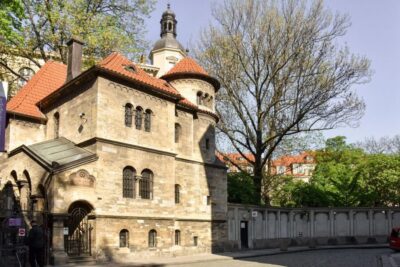
Jewish Quarter Ticket with optional Audio Guide
Read our review →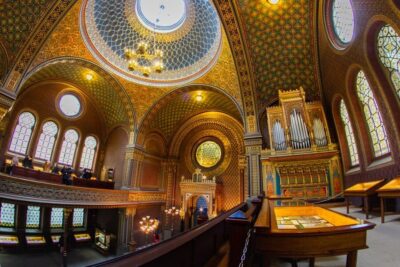
Prague’s TOP Sights – Old Town, Jewish Quarter, Charles Bridge (Tip-based tour)
Read our review →
Prague Old Town New Town and Jewish Quarter Morning Tour
Read our review →
Old Town, Jewish Quarter & Astro Clock Walking Tour
Read our review →
Prague Essential Tour Old Town and Jewish Quarter
Read our review →Browse the lists this tour appears in