
REVIEW · WALKING TOURS
Prague: Highlights Walking Tour to the German embassy 1989
Freedom changed on a Prague balcony. This 150-minute walking tour links the city’s famous sights with the dramatic events of 1968 and 1989. I like its clear focus on modern Czech history, and I like that it takes you beyond postcard Prague into places tied to the Velvet Revolution and the East German refugee crisis. The main drawback is simple: the tour is conducted in German, and the steady walking may not suit anyone with limited mobility.
You’ll cross Charles Bridge, see the John Lennon Wall, pass through Josefov, and finish near the German Embassy in Lesser Town. I also appreciate the emotional detail behind the route: the guide explains Jan Palach’s story and the moment Hans-Dietrich Genscher announced that East German refugees could leave Prague. The embassy interior is closed to the public, so you see the famous balcony from outside rather than entering the building.
In This Review
- Key points before you book
- Why this Prague walk is different
- Meeting at the Faculty of Law
- Čech’s Bridge and the Jewish Quarter
- Jan Palach Square and the meaning of 1968
- The Velvet Revolution Memorial
- Crossing Charles Bridge
- John Lennon Wall and a living memorial
- Wenceslas Square and the National Museum
- Returning to Lesser Town
- The German Embassy and Genscher’s balcony
- Guide quality and language
- Is $32 a fair price?
- Who should book this walking tour?
- FAQ
- How long does the Prague walking tour last?
- What language is the tour conducted in?
- Where does the tour begin?
- How do I reach the Faculty of Law meeting point?
- Can I be picked up at my hotel?
- Can I enter the German Embassy?
- Is food or drink included?
- Is the tour suitable for people with mobility impairments?
- Should you book it?
Key points before you book
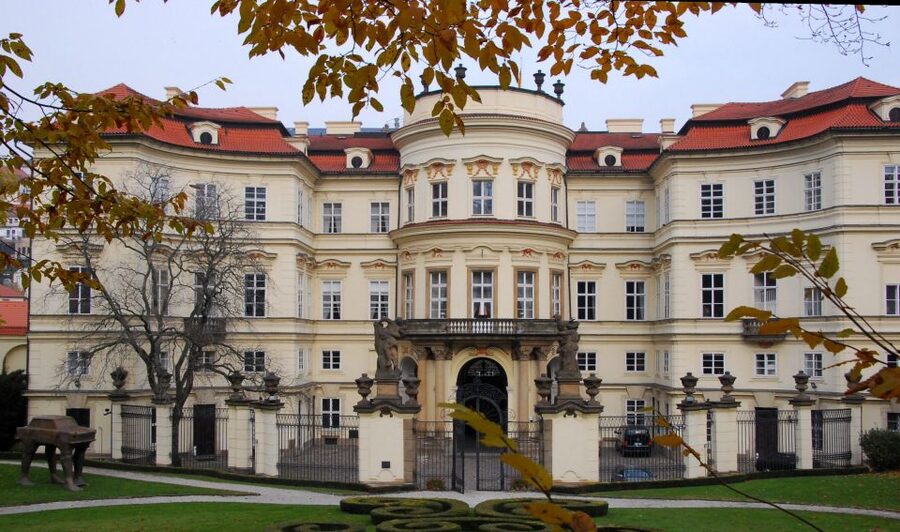
- The German Embassy balcony is viewed from outside: You can see the place linked to Genscher’s 1989 announcement, but the embassy itself is not open to the public.
- The tour connects 1968 and 1989: Jan Palach’s protest and the fall of communism are presented as parts of Prague’s larger 20th-century story.
- Charles Bridge is one of several major sights: The route also includes Josefov, Wenceslas Square, Jan Palach Square, the John Lennon Wall, and Malostranské Square.
- The tour is in German: A licensed German-speaking guide leads the walk, with David Klaus named as the provider.
- Plan for continuous walking: The tour is not suitable for people with mobility impairments, and there is no food or drink included.
- The price is $32 per person: That is fair for a small, history-focused city walk, especially if you want explanation rather than a quick photo stop.
Why this Prague walk is different
Prague offers plenty of tours about medieval towers, royal churches, and astronomical clocks. This one takes a different path. It uses familiar central Prague sights as markers for the city’s more recent political story.
You still get the classic views. Čech’s Bridge, Charles Bridge, the narrow streets of Josefov, Wenceslas Square, and Lesser Town all appear along the way. But the guide’s main job is to explain what happened in these places during the Prague Spring, the Soviet-led invasion of 1968, the years of communist rule, and the Velvet Revolution of 1989.
That makes the tour especially useful if you have already seen Prague’s main buildings but feel you are missing the meaning behind the city. The route is not simply a list of monuments. It shows how public squares, university buildings, walls, bridges, and embassies became stages for political change.
The focus on East German refugees gives the walk an unusual angle. In 1989, people from East Germany fled through neighboring countries and gathered at the West German Embassy in Prague. The embassy became crowded with people seeking permission to leave for the West. The famous balcony scene is the emotional endpoint of the tour.
More Walking Tours in Prague:
- Prague: 3-Hour Walking Tour of Old Town & Prague Castle
★ 4.7 · 5,696 reviews - Prague: Ghost Walking Tour Where Legends Come To Life
★ 4.4 · 5,253 reviews - Prague: Jewish Quarter Walking Tour with Admission Tickets
★ 4.7 · 3,729 reviews
Meeting at the Faculty of Law
The usual meeting point is in front of the Faculty of Law at Charles University, at nám. Curieových 7 in Prague’s Old Town. From Staroměstská metro station, you walk about 550 meters to reach the meeting point. Tram 17 stops at Pravnicka Fakulta, which is another practical option.
Pickup can also be arranged from a hotel in Prague 1, 2, or 3, or from the city center near Můstek, depending on the selected option. Hotel pickup is not automatically part of the basic price, so check the booking choice carefully.
The starting point beside the Faculty of Law makes sense for the subject. You begin near the Old Town and the Vltava, then move through places where Prague’s public and intellectual life has unfolded. Wear comfortable shoes. The route includes bridges, squares, pavements, and city streets, with several short stops along the way.
The tour lasts 150 minutes. That sounds generous, but the route covers a lot of ground. The listed stops include short photo pauses of five to fifteen minutes, along with walking between them. You should expect a purposeful city walk rather than a slow stroll with long breaks.
Čech’s Bridge and the Jewish Quarter
The first sightseeing stop is Čech’s Bridge, a useful place to begin looking at Prague from the river. You get scenic views and a photo opportunity before turning toward Josefov, the former Jewish quarter.
The Old Jewish Cemetery and Josefov are listed as separate stops. The cemetery receives a short photo stop, while the surrounding quarter gives the guide room to explain how this part of Prague fits into the city’s changing identity. Since the stop is brief, you should not expect an extended cemetery visit or a full Jewish Quarter tour.
Still, the location helps set the tone. Prague’s center is not one single story. Medieval streets, religious sites, political demonstrations, and 20th-century upheaval all sit close together. The guide uses that compact geography to move from the city’s older neighborhoods toward its modern political past.
Jan Palach Square and the meaning of 1968
Jan Palach Square is one of the most important stops for understanding the tour’s historical thread. Palach was a student at the Faculty of Philosophy who became a symbol of resistance after the Prague Spring and the Soviet invasion of Czechoslovakia in 1968.
The guide explains Palach’s fate and why his name remains tied to the city’s memory of that year. The tour does not treat 1968 as a footnote before rushing to 1989. Instead, it shows how the disappointment and repression that followed the Prague Spring shaped later opposition to communist rule.
This stop is valuable because it gives the political story a human face. You are not only hearing about governments and borders. You are learning about a student whose protest forced people to confront what had happened to their country.
The visit lasts about ten minutes, including a guided explanation and a photo stop. That is enough for a focused introduction, but readers who want a detailed account of Palach’s life should plan a separate visit to learn more.
A few more Prague options to compare
- Prague: 50-Minute Sightseeing Evening Cruise
★ 4.2 · 33,780 reviews - Prague: Medieval Dinner with Unlimited Drinks
★ 4.4 · 19,847 reviews - Prague: Skip-the-line Castle Ticket and Optional AudioGuide
★ 4.3 · 11,121 reviews - Prague: Castle Tour with Local Guide and Entry Ticket
★ 4.6 · 10,422 reviews
The Velvet Revolution Memorial
The route then reaches a memorial connected with the Velvet Revolution. This is where the tour turns more directly toward the events of 1989 and the end of communist rule in Czechoslovakia.
The word velvet refers to the largely peaceful nature of the political transition. That does not mean the period lacked tension or risk. The guide explains how demonstrations, public pressure, and political change came together during the final weeks of communist rule.
A fifteen-minute stop gives this section more time than several of the photo pauses. That matters. The end of communism was not one isolated announcement. It was a process, and the memorial provides a point for connecting the street-level events with the wider collapse of communist governments across Central Europe.
I would pay close attention here if you are unfamiliar with the difference between the Prague Spring of 1968 and the Velvet Revolution of 1989. The tour links the two without treating them as the same event.
Crossing Charles Bridge
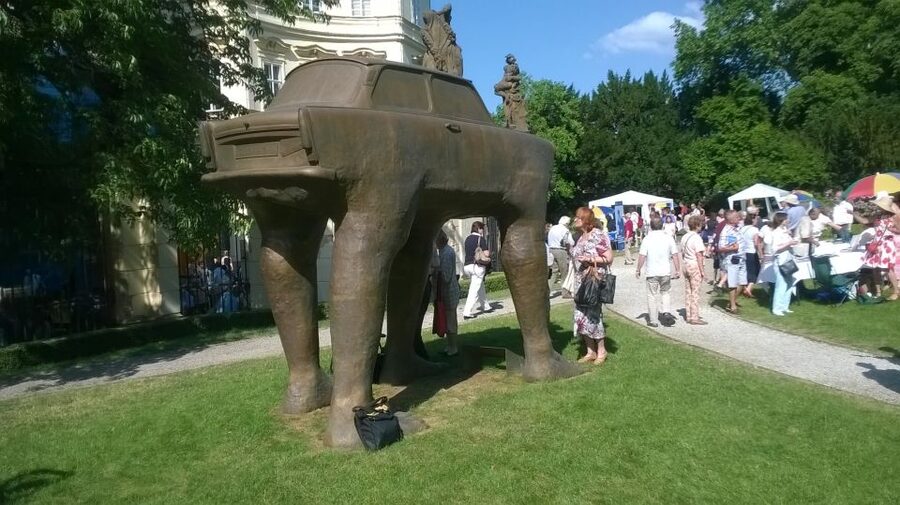
Charles Bridge is the route’s best-known landmark. You walk across it while taking in the river views, statues, and long views toward Prague Castle and Lesser Town. The tour allows about fifteen minutes for this section.
That is enough to cross and hear the guide’s explanation, but not enough for a leisurely examination of every statue. Charles Bridge is often crowded, and the walk may take longer if the flow of people is slow. Stay close to the guide and keep your attention on the meeting point at the far side.
The bridge works well in this tour because it links Old Town and Lesser Town both physically and historically. You leave the areas around Josefov and the Old Town behind, then enter the streets leading toward the German Embassy.
If you have never crossed Charles Bridge, this is a welcome inclusion. If you have already photographed it several times, the guide’s historical framing gives the crossing a fresh purpose.
John Lennon Wall and a living memorial
The John Lennon Wall offers a more informal stop. Its layers of writing, painted images, and messages form a public memorial associated with peace, freedom, and opposition to communist control.
The guide includes time for sightseeing, explanation, and photographs. The wall changes over time, so the exact appearance you see is not fixed. That is part of its appeal. It is less like a finished monument and more like an ongoing public display.
This stop also gives the tour a change of pace. After the formal memorials and political squares, the wall feels personal and creative. It helps explain how music, art, and public expression became important forms of resistance.
Do not expect a long visit. The scheduled stop is about ten minutes. That works for seeing the wall and hearing its background, but anyone wanting detailed photographs may need to return independently.
Wenceslas Square and the National Museum
Wenceslas Square brings the tour back toward Prague’s major civic center. Despite its name, it is a broad urban boulevard rather than a traditional enclosed square. The space has been tied to demonstrations, speeches, and major public events, making it a natural place to discuss the final years of communist rule.
The stop lasts about fifteen minutes and includes sightseeing. You also see the Prague National Museum, with roughly five minutes set aside for a photo stop. The museum building gives the route a strong visual marker, even though the tour does not include an interior museum visit.
This part of the walk helps you understand how Prague’s public squares function. Wenceslas Square is not merely a place for shopping and photographs. It has long been a setting for people to gather, make demands, and witness political change.
Because the museum visit is only a photo stop, do not book this tour expecting admission to the National Museum. If you want to explore its exhibitions, set aside another part of your Prague schedule.
Returning to Lesser Town
After the central city stops, the route heads back toward Lesser Town. Malostranské Square appears as another photo stop, followed by about ten minutes on foot toward the embassy.
This portion may feel less structured than the main landmarks, but it completes the geography of the story. You have crossed from Old Town to Lesser Town, then moved through the streets toward the diplomatic site that became central to the 1989 refugee crisis.
Malostranské Square is also the finish area. The tour does not return you to a hotel, and there is no included transport back to your accommodation. That is not a serious problem in central Prague, but you should check your route before setting off for another appointment.
The German Embassy and Genscher’s balcony
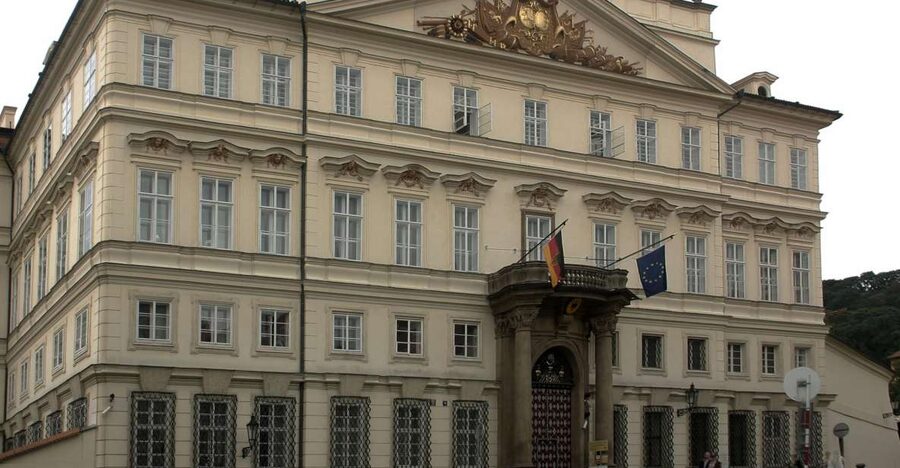
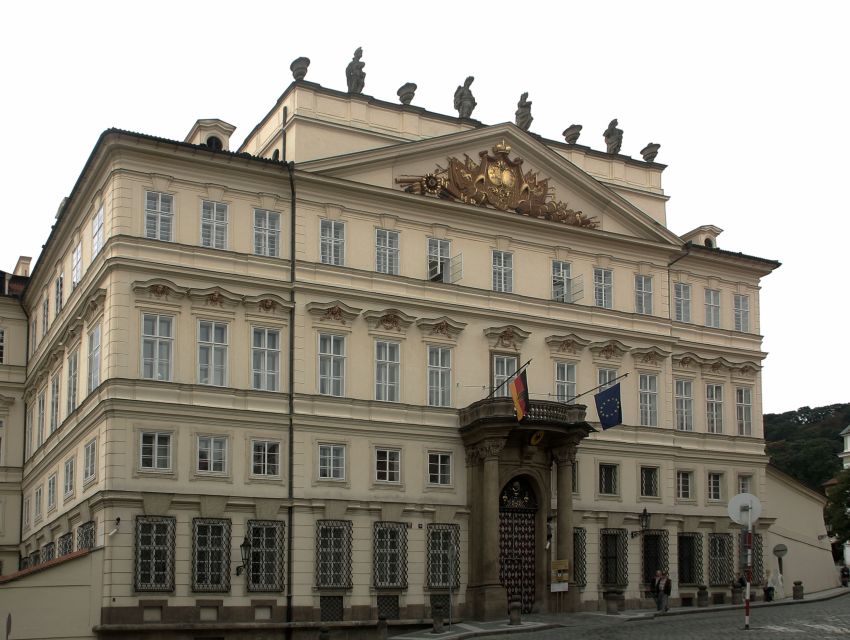
The final major stop is the Embassy of Germany in Prague. From outside, the guide points out the building and the balcony associated with Hans-Dietrich Genscher, then Foreign Minister of the Federal Republic of Germany.
In 1989, East German citizens had fled through Poland and Hungary and gathered at the West German Embassy in Prague. The embassy grounds became a refuge for people hoping to leave East Germany. Genscher’s announcement from the balcony that they could depart became one of the defining scenes of the peaceful end of communist rule in Central Europe.
The tour gives you about ten minutes at the embassy. The interior is not open to the public, so this is an exterior viewing rather than an embassy visit. That limitation is important. The value comes from the guide’s explanation and from standing outside the location where the announcement took place.
The emotional importance of this stop is clear from one private booking. Rene, visiting in November 2024, returned with his wife to the embassy area after 36 years. She had been there with her parents in 1989 and had heard the happy news from the balcony beside Genscher. That personal connection shows why this site can mean far more than a standard photo stop.
Guide quality and language
The tour is led by a licensed German-speaking guide. David Klaus is the named travel manager and provider, and Christina’s June 2021 booking specifically praised David for guiding the tour well and answering questions.
That detail matters because this experience depends heavily on explanation. The embassy balcony, Jan Palach Square, and the Velvet Revolution Memorial are meaningful only if the guide can connect them clearly. A strong German-speaking guide is a major part of the value.
The tour is not presented in English according to the supplied information. If you are not comfortable following detailed historical explanations in German, choose another tour. Private groups are available, which may suit families or friends who want a more personal pace and the chance to ask more questions.
Is $32 a fair price?
At $32 per person, the tour sits in a reasonable range for a 2.5-hour guided walk through central Prague. You are paying for a licensed guide, a carefully connected route, and historical interpretation rather than entry tickets.
The value is strongest if you want to understand the political meaning of Prague’s streets. You see the major landmarks, but the tour does not include food, drinks, museum admission, or access inside the German Embassy. Those costs and visits would need to be arranged separately.
A private group can make the price more worthwhile if several people share the booking. For a solo participant, the decision depends on your interest in modern European history and your comfort with walking at a steady pace.
The free cancellation period runs until 24 hours before the tour, and you can reserve now and pay later. Those terms make it easier to fit the walk into a changing Prague schedule.
Who should book this walking tour?
I would recommend it to German-speaking visitors who want more than Prague’s medieval highlights. It is particularly well suited to:
- People interested in the Prague Spring and the Velvet Revolution
- Anyone curious about the 1989 East German refugee crisis
- First-time visitors who want a broad introduction to central Prague
- Returning visitors who have already seen Charles Bridge and the Old Town
- Families or private groups who want to ask questions along the way
- Anyone with a personal connection to the events of 1989
I would hesitate if your main goal is to enter historic buildings, spend a long time at each landmark, or avoid walking. The embassy is viewed only from outside, the National Museum is not visited inside, and the short stops keep the route moving.
FAQ
How long does the Prague walking tour last?
The tour lasts 150 minutes, or two and a half hours.
What language is the tour conducted in?
The tour is conducted in German by a licensed German-speaking guide.
Where does the tour begin?
The standard meeting point is in front of the Faculty of Law at Charles University, nám. Curieových 7 in Prague’s Old Town.
How do I reach the Faculty of Law meeting point?
From Staroměstská metro station, the meeting point is about 550 meters away. You can also take tram 17 to the Pravnicka Fakulta stop.
Can I be picked up at my hotel?
Optional pickup is available from hotels in Prague 1, 2, or 3, or from the city center near the Můstek metro station, depending on the selected option.
Can I enter the German Embassy?
No. The embassy interior is not open to the public. The tour views the building and the balcony associated with Hans-Dietrich Genscher from outside.
Is food or drink included?
No. Food and drinks are not included.
Is the tour suitable for people with mobility impairments?
No. The experience is not suitable for people with mobility impairments because it involves substantial walking between central Prague sights.
Should you book it?
Book this tour if you want Prague’s landmarks tied together by the city’s 20th-century political story. The combination of Jan Palach Square, the Velvet Revolution Memorial, Charles Bridge, the John Lennon Wall, and Genscher’s balcony gives the walk a clear purpose.
Skip it if you need an English-language tour, want interior visits, or prefer a slower route with long stops. For German-speaking history enthusiasts, especially anyone interested in 1989, $32 is a sensible price for a focused walk that ends at one of Prague’s most moving political locations.
Newest listings in Prague
- World War II 4WD Tour from Prague with Lunch★ 4.4 · 3 reviews
- WWII and Communism History in Prague’s Old Town Private Tour★ 5.0 · 4 reviews
- Wroclaw: Giant Mountains & Valley of Palaces Day Tour★ 4.8 · 36 reviews
- Prague: Historical Walking Tour with Focus on World War 2★ 4.3 · 12 reviews
- Walking tour of Prague in French : Nové Město★ 4.9 · 16 reviews
- Walking tour of Prague in french: Old Town & Charles Bridge★ 4.9 · 62 reviews
- Vltava River Cruise and Private Tour of Prague’ Old Town★ 5.0 · 1 review
- Ultimate Unlimited Beer Pong with Czech Beer★ 4.6 · 5 reviews
Walking Tours, compared.
3-Hour Walking Tour of Old Town & Prague Castle
Read our review →
Ghost Walking Tour Where Legends Come To Life
Read our review →
Jewish Quarter Walking Tour with Admission Tickets
Read our review →
Prague Guided Walking Tour and Cruise with Authentic Czech Lunch
Read our review →
Old Town and Jewish Quarter Guided Walking Tour
Read our review →
Prague Ghost and Legend of Old Town Walking Tour
Read our review →
Prague 3-hour Afternoon Walking Tour including Prague Castle
Read our review →
Ghosts and Legends Nighttime Guided Walking Tour
Read our review →Browse the lists this tour appears in