
REVIEW · WALKING TOURS
Prague Art Nouveau and Cubism Walking Tour
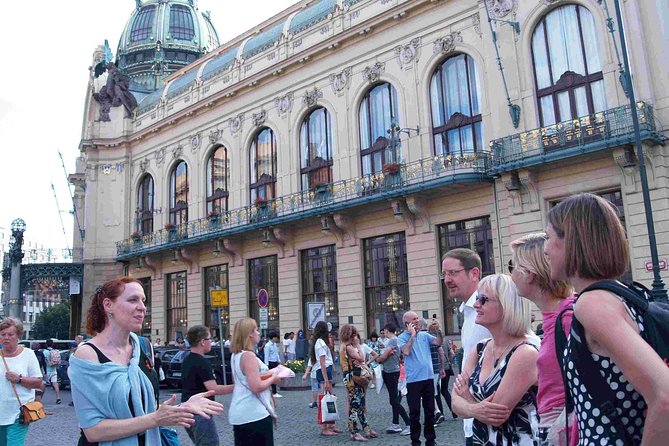
Look up, and Prague changes shape. This three-hour walk connects elegant Art Nouveau façades, sharp Cubist angles, grand cafés, and Czech political history in a way that makes the city easier to read. I especially like the small maximum of eight people, which gives the historian guide room to answer questions and adjust the pace. I also like the access to interiors such as Lucerna, Café Imperial, and the main train station, places you could easily pass without understanding their design.
The main drawback is the price: $126.71 per person is a serious sum for a walking tour with no food, drinks, or transport included. Still, the cost makes more sense if you want expert interpretation rather than a simple stroll past pretty buildings. The tour is best for curious walkers who enjoy architecture, history, and the stories behind a city’s grand façades.
In This Review
- Key points before you book
- Why Prague is ideal for an architecture walk
- Starting at Ovocný trh
- House of the Black Madonna and Prague Cubism
- Obecni Dum, Prague’s Art Nouveau showpiece
- K+K Hotel Central and Café Imperial
- The Czechoslovak Legion Bank
- Prague Main Train Station and the value of overlooked interiors
- Wenceslas Square and the making of modern Prague
- Lucerna and a glimpse of Czech optimism
- The upside-down King Wenceslas
- What the guides add to the experience
- Price, group size, and practical value
- Who should book this Prague walk
- Final verdict: a smart choice for curious first-time visitors
- FAQ
- How long is the Prague Art Nouveau and Cubism Walking Tour?
- Where does the tour begin?
- Where does the tour end?
- What time does the tour start?
- How many people can join the tour?
- What is included in the price?
Key points before you book
- Prague’s design story in three hours: Move from Art Nouveau curves to Cubist crystals, then on to Art Deco and modern symbolism.
- A true small-group format: The tour has a maximum of eight people, making questions and personal interests easier to accommodate.
- Interiors matter here: You may see details inside Lucerna, Café Imperial, Prague Main Train Station, and other public buildings.
- History gives the buildings meaning: The guide connects architecture with Czech nationalism, economic change, political upheaval, and European wars.
- A strong first-day choice: The tour can give you a useful visual guide for the rest of your stay in Prague.
- Flexible morning or afternoon timing: The listed start is 10:00 a.m., with morning and afternoon departures offered.
Why Prague is ideal for an architecture walk
Prague is famous for its medieval lanes and Baroque churches, but its late 19th and early 20th century buildings tell another story. This was a period of confidence, invention, national pride, and artistic experimentation. Art Nouveau supplied flowing lines, floral forms, decorative lettering, and elaborate interiors. Cubism took a harder turn, using facets, pyramids, and crystal-like shapes in architecture.
The tour helps you see that these styles were not just visual choices. They reflected changing ideas about Czech identity, modern life, technology, and the future. A building becomes more interesting when you know why its architect chose a curved plant motif instead of a straight line, or why a façade seems to break into geometric shards.
I like this approach because it gives you a practical skill. After the tour, you can walk through Prague and spot Art Nouveau details on your own. Look for gingko leaves, curving typography, metalwork, colored glass, and decorative lamps. Then compare them with Cubist surfaces, which often seem to fold outward like cut stone.
More Walking Tours in Prague:
- Prague: 3-Hour Walking Tour of Old Town & Prague Castle
★ 4.7 · 5,696 reviews - Prague: Ghost Walking Tour Where Legends Come To Life
★ 4.4 · 5,253 reviews - Prague: Jewish Quarter Walking Tour with Admission Tickets
★ 4.7 · 3,729 reviews
Starting at Ovocný trh
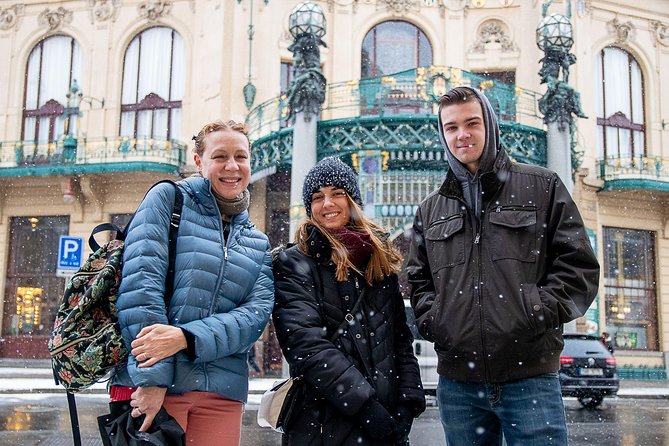
The tour begins at Ovocný trh 19 in Prague’s Old Town, a central location close to major sights and public transportation. That makes it easy to fit into a day of sightseeing, though you should allow enough time to reach the meeting point without rushing.
From here, the walk moves through central Prague rather than taking you far into the suburbs. That is convenient, but it also means you will be on city streets for most of the experience. Wear comfortable shoes and expect a steady walking pace. The duration is about three hours, so the tour is long enough to build a clear story without taking up an entire day.
The small group is one of the strongest practical features. With no more than eight people, the guide can point out details without losing half the group at a busy crossing. The format also makes it easier to ask about your own interests. Several guides have adjusted the route or discussion for people especially interested in Cubism, Art Deco, or particular buildings.
House of the Black Madonna and Prague Cubism
The House of the Black Madonna is an essential first stop. This unusual building introduces you to Prague’s Cubist side, with forms that are less soft and decorative than the Art Nouveau façades nearby.
You get about ten minutes here. That is enough for an explanation and a close look, but not enough for a long architectural study. Pay attention to the building’s angular lines and the way its design treats the façade as a set of geometric planes rather than a flat wall.
This stop works well early in the walk because it gives you a clear comparison point. Once you have seen the Cubist approach, the floral curves of Art Nouveau become easier to recognize. Prague was one of Europe’s leading centers for Cubist art, and the tour shows why the city is unusually rewarding for anyone interested in this style.
Obecni Dum, Prague’s Art Nouveau showpiece
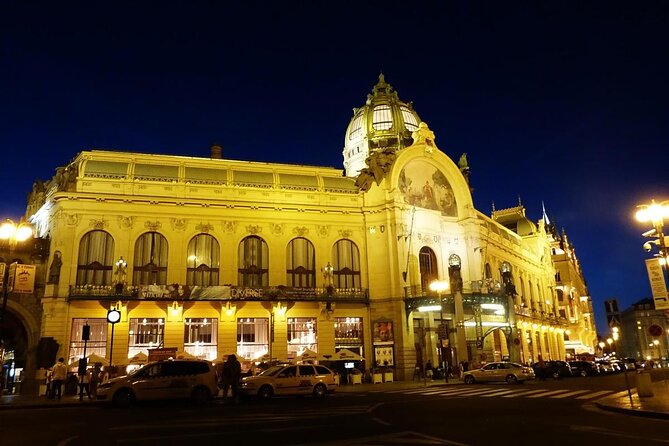
Obecni Dum, or the Municipal House, is one of the most impressive Art Nouveau buildings in the city. The tour allows about 15 minutes here, enough to discuss its exterior and the broader importance of the building.
This is where you can start looking for the details that define the style: plant forms, ornamental surfaces, sweeping curves, and decorative lighting. The guide also explains the technology that helped make buildings of this period feel modern. Central heating, ventilation, drinking water systems, hydraulic elevators, steam-powered laundry, and intercoms were part of the new urban world.
That technical side is important. Art Nouveau was not only about decoration. It appeared alongside new systems that changed how people lived and how buildings operated. Hearing about those systems gives the ornate design a practical context.
A few more Prague options to compare
- Prague: 50-Minute Sightseeing Evening Cruise
★ 4.2 · 33,780 reviews - Prague: Medieval Dinner with Unlimited Drinks
★ 4.4 · 19,847 reviews - Prague: Skip-the-line Castle Ticket and Optional AudioGuide
★ 4.3 · 11,121 reviews - Prague: Castle Tour with Local Guide and Entry Ticket
★ 4.6 · 10,422 reviews
K+K Hotel Central and Café Imperial
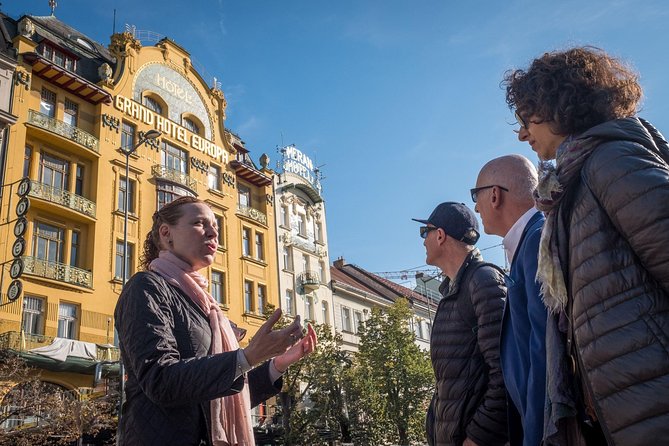
The K+K Hotel Central is described as Prague’s first Art Nouveau building, with about ten minutes devoted to the stop. If you are staying there, this part of the walk has an extra benefit: you can return later and look at your own hotel with fresh eyes.
One of the most useful lessons from this tour is that architecture is not confined to famous monuments. Hotels, banks, restaurants, cafés, stations, and arcades all carry the marks of their period. The K+K building makes that point clearly.
Nearby Café Imperial receives a shorter five-minute stop, but its interior is worth noticing. Art Nouveau is often strongest inside, where ceramics, decorative surfaces, lamps, and curved forms work together. The time here is brief, so treat it as a focused look rather than a meal break. Food and drinks are not included.
If you want to return for a meal or coffee, the tour gives you a reason to do so. You will know what to look for instead of simply seeing an attractive old café.
The Czechoslovak Legion Bank
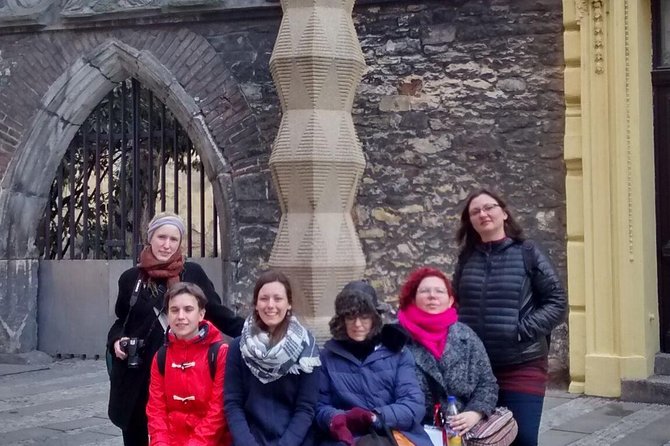
The Czechoslovak Legion Bank adds a political and national layer to the walk. Its Cubist architecture and interior connect design with the Czechoslovak Legion of the First World War.
This is a good example of how the tour moves beyond style spotting. A bank is not just a bank here. Its decoration and purpose relate to national memory, military service, and the formation of modern Czech identity.
The stop lasts about ten minutes. That should be enough for the guide to explain the building’s role and point out its angular Cubist features. If you are mainly interested in Art Nouveau, this stop may feel like a change of direction. That contrast is useful, though, because it shows that Prague’s early 20th-century design was not one uniform movement.
Prague Main Train Station and the value of overlooked interiors
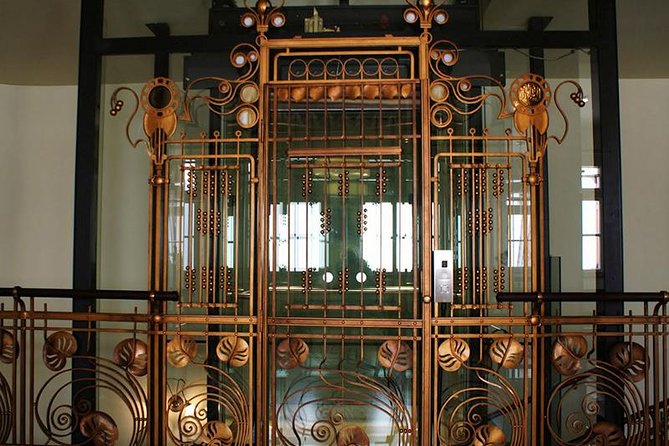
Prague Main Train Station receives another ten-minute stop. Its magnificent interior Art Nouveau dome is the reason to pay attention here.
Railway stations can be easy to ignore when you are focused on getting somewhere, but they often reveal how a city presented itself to the outside world. Grand interiors, new engineering, and decorative details made the station part of Prague’s public image.
One particularly practical benefit is that the guide may help you understand the station itself. A guide named Vad was praised for showing how to navigate the main station while explaining its architecture. That is a useful combination: you get both a design lesson and help with a place that can otherwise feel confusing.
The tour also has a habit of bringing attention to public interiors that you might not enter on your own. A post office mural was singled out as an example of this kind of discovery. The exact interiors you see can depend on access and the guide’s route, so do not treat every interior as guaranteed. The general strength of the tour is its attention to places beyond the standard postcard views.
Wenceslas Square and the making of modern Prague
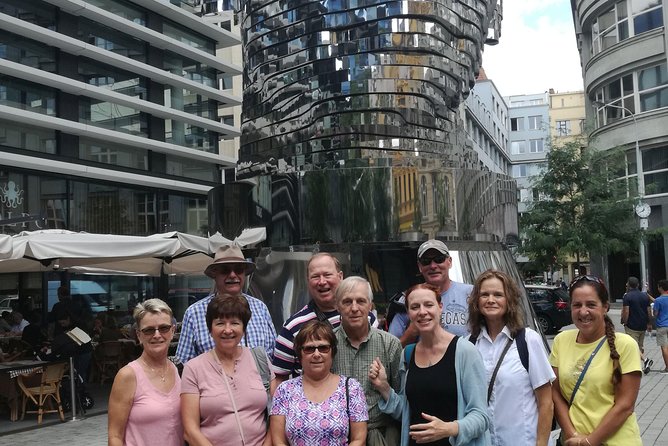
Wenceslas Square gives the guide room to connect Art Nouveau and Art Deco with Czech history. The stop lasts about 15 minutes, making it one of the longer discussions on the route.
The square is useful because it brings architecture and public life together. Its buildings reflect changing tastes, while the space itself has been tied to major moments in Czech history. The guide places design within the story of national revival, political pressure, and the wars that reshaped Prague and Europe.
This is the point where the tour becomes more than an architecture lesson. The buildings help explain how Czech society saw itself, how it wanted to appear, and how those hopes changed through conflict. If you like history but are not sure you care about architectural labels, this section may win you over.
Lucerna and a glimpse of Czech optimism
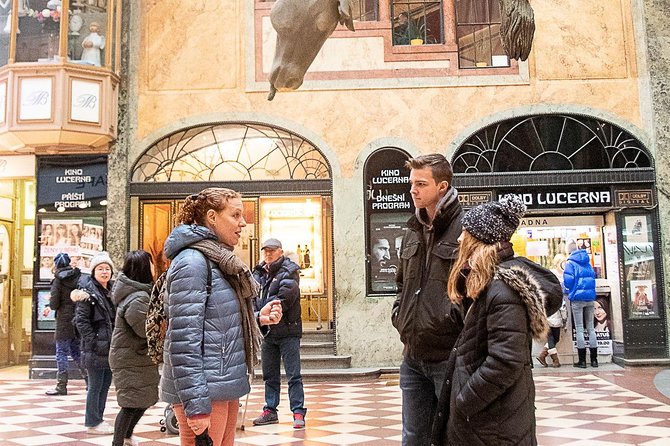
Lucerna Music Bar is one of the most appealing stops. You get about ten minutes to see the Art Nouveau interior of one of Prague’s most beautiful arcades.
The setting reflects the optimism and avant-garde spirit of the turn of the century. It also shows how a building can function as a social space, not simply an object to admire from the pavement. Pay attention to the arcade’s decoration and the way the interior creates a sense of occasion.
The guide uses Lucerna to discuss the hopes of the period and the effect of fierce European wars on Prague’s direction. This contrast is one of the tour’s best ideas. The polished interiors suggest confidence and progress, while the historical discussion explains how quickly that confidence could be shaken.
You may want to return to Lucerna later, especially if you enjoy historic cafés, arcades, and music venues. The tour does not include entertainment or refreshments, but it can help you decide which places deserve a second visit.
The upside-down King Wenceslas
The final stop is the upside-down statue of King Wenceslas riding a dead horse. This contemporary sculpture shifts the tour from period architecture to modern political symbolism.
The guide discusses the statue in relation to Czech history and the Czech National Revival. It is a playful, strange image, but it rewards a serious explanation. After several hours of looking at buildings created during a period of national confidence, the sculpture offers a modern comment on authority, memory, and public identity.
This ending also prevents the walk from becoming too neatly boxed into Art Nouveau and Cubism. Prague’s design story continues beyond the early 20th century, and the statue shows how later artists respond to older national symbols.
What the guides add to the experience
The strongest part of this tour is the guide. The experience is led by a historian, and the feedback consistently praises the guides for combining architecture with politics, economics, and Czech society.
Names mentioned include Vadim, Vad, Betty, Bonita, Matous, and Vitam. You cannot assume which guide you will receive, but the range of praise suggests that the company places real emphasis on personal expertise and storytelling.
Vadim is noted for tailoring the walk to interests in Cubism and Art Deco. Betty adjusted a private tour for strong walkers and even used a tram to reach a more distant area. Bonita was praised for placing each building in artistic and historical context. Matous brought particular enthusiasm for the Art Nouveau period.
These details matter because a small group works best when the guide treats it as a conversation. You should feel free to ask why a building looks the way it does, how the style spread, or where to find a good place to eat afterward. One guide pointed out restaurants after the walk, while another helped with the main train station.
Price, group size, and practical value
At $126.71 per person, this is not a budget walking tour. You are paying for a three-hour experience with a historian guide, a maximum group size of eight, and access to expert interpretation rather than admission tickets.
There are no entrance fees listed, and food, drinks, hotel pickup, and hotel drop-off are not included. The value therefore depends on your priorities. If you only want a quick introduction to Prague’s main sights, the price may feel high. If you want to understand design details that would otherwise pass unnoticed, the small group and specialist guide make the cost easier to justify.
The tour is booked an average of 69 days ahead, so early planning is sensible, especially if you want a particular departure time. Morning and afternoon options are offered, with the listed start at 10:00 a.m.
Most people can take part, and the route is near public transportation. Since this is a walking tour through central Prague, plan for outdoor exposure and comfortable footwear. Rain does not necessarily ruin the experience. Vad was praised for keeping a rainy-day walk engaging and for continuing to show both public and private examples.
Free cancellation is available if you cancel at least 24 hours before the start time. Changes or cancellations inside that window are not accepted for a refund.
Who should book this Prague walk
I would choose this tour early in a Prague stay if you enjoy architecture, history, photography, or city design. The explanations can sharpen the rest of your sightseeing, helping you notice details in hotels, banks, stations, cafés, and arcades.
It also suits families with older children and mixed-age groups. The reported age range ran from 19 to 76, and the format can work well when not everyone wants a traditional museum visit.
You do not need to arrive as an architecture expert. In fact, the tour may be more useful if you are starting from scratch. The guide explains how to recognize Art Nouveau, Cubism, and Art Deco, then shows how those styles connect to Czech history.
I would be more cautious if you dislike walking, want extensive time inside each building, or prefer a cheap sightseeing overview. The stops are short, and some interiors may depend on access at the time of the visit.
Final verdict: a smart choice for curious first-time visitors
Book this tour if you want Prague to become easier to understand, not just easier to photograph. The strongest features are the tiny group, the historian guides, the mix of famous buildings and overlooked interiors, and the links between architecture, technology, national identity, and war.
The price is high, but the experience offers more than a list of façades. Choose it near the start of your stay, ask plenty of questions, and return to the cafés, arcades, or buildings that catch your eye. For anyone drawn to Art Nouveau, Cubism, or the story of modern Prague, this is a focused and unusually worthwhile introduction.
FAQ
How long is the Prague Art Nouveau and Cubism Walking Tour?
The tour lasts approximately three hours.
Where does the tour begin?
The meeting point is Ovocný trh 19, Staré Město, 110 00 Prague, Czechia.
Where does the tour end?
The tour ends at Café Louvre, Národní 22, 110 00 Prague 1, Czechia.
What time does the tour start?
The listed start time is 10:00 a.m. Morning and afternoon departure options are offered.
How many people can join the tour?
The group has a maximum of eight participants.
What is included in the price?
A historian guide is included. Food, drinks, hotel pickup, hotel drop-off, and admission tickets are not included unless specifically stated.
Newest listings in Prague
- World War II 4WD Tour from Prague with Lunch★ 4.4 · 3 reviews
- Prague: Historical Walking Tour with Focus on World War 2★ 4.3 · 12 reviews
- WWII and Communism History in Prague’s Old Town Private Tour★ 5.0 · 4 reviews
- Wroclaw: Giant Mountains & Valley of Palaces Day Tour★ 4.8 · 36 reviews
- Walking tour of Prague in French : Nové Město★ 4.9 · 16 reviews
- Walking tour of Prague in french: Old Town & Charles Bridge★ 4.9 · 62 reviews
- Vltava River Cruise and Private Tour of Prague’ Old Town★ 5.0 · 1 review
- Ultimate Unlimited Beer Pong with Czech Beer★ 4.6 · 5 reviews
Walking Tours, compared.
3-Hour Walking Tour of Old Town & Prague Castle
Read our review →
Ghost Walking Tour Where Legends Come To Life
Read our review →
Jewish Quarter Walking Tour with Admission Tickets
Read our review →
Prague Guided Walking Tour and Cruise with Authentic Czech Lunch
Read our review →
Old Town and Jewish Quarter Guided Walking Tour
Read our review →
Prague Ghost and Legend of Old Town Walking Tour
Read our review →
Prague 3-hour Afternoon Walking Tour including Prague Castle
Read our review →
Ghosts and Legends Nighttime Guided Walking Tour
Read our review →Browse the lists this tour appears in