
REVIEW · JEWISH QUARTER TOURS
Prague: 2-Hour Old Town and Jewish Ghetto Walking Tour
Prague rewards a slow start. This two-hour Old Town and Jewish Ghetto walk gives you a useful first look at the city’s major sights, from the Astronomical Clock and Jan Hus Monument to Josefov’s historic synagogues. I like the strong mix of Czech and Jewish history, and I like that the route includes places many short city walks skip, such as the Estates Theatre, House of the Black Madonna, and Franz Kafka’s birthplace.
I also like the small-group limit of 15 people and the option to book a private group. The main trade-off is pace: you cover a lot of ground in two hours, and the tour includes exteriors only, so you will not enter the synagogues, cemetery, churches, or other buildings.
In This Review
- Key points about this Prague walking tour
- Why this two-hour route works as a Prague introduction
- Meeting behind Týn Cathedral
- Old Town Square, Jan Hus, and the Astronomical Clock
- Charles University and Prague’s place in Central Europe
- Estates Theatre and the House of the Black Madonna
- Entering Josefov, Prague’s former Jewish quarter
- Franz Kafka’s Prague and the final walk back
- Guide quality and the pace of the experience
- Is $23 good value for two hours?
- Who should book this walk?
- Should you book the Prague Old Town and Jewish Ghetto tour?
- FAQ
- How long does the Prague Old Town and Jewish Ghetto tour last?
- How much does the tour cost?
- What language is the tour offered in?
- Where does the tour begin?
- Where does the tour finish?
- What sights are included on the route?
- Does the tour include entry to the synagogues or other buildings?
- How large is the group?
- Can I cancel or pay later?
Key points about this Prague walking tour
- The route links Old Town Square with Josefov, giving you both Prague’s grand civic center and its former Jewish quarter.
- The Astronomical Clock gets proper attention, including the meaning behind its unusual symbols.
- Jan Hus provides a direct link to Czech identity, religion, and the long story of Bohemia.
- Josefov is seen from the outside, including Maisel, Klausen, Old-New, and Spanish synagogues.
- Franz Kafka appears twice in the story, through his birthplace and the Kafka Monument.
- A 15-person maximum keeps the walk fairly personal, with English-speaking guides and private-group availability.
Why this two-hour route works as a Prague introduction
I see this tour as a practical orientation walk rather than a full historical course. For $23 per person, you get two hours with a live English-speaking guide, a route through the city center, and an explanation of why the buildings matter. That is fair value if you are new to Prague and want the pieces arranged before exploring on your own.
The tour covers roughly a thousand years of political, religious, cultural, and Jewish history in a short time. That sounds ambitious, and it is. You will hear the broad story rather than every detail, but the route gives you a useful map of the historic center.
The experience has earned a 4.9 rating from 78 ratings, with particular praise for guides including Krystoff, Allen, Allan, Radek, Dana, and Martin. The strongest pattern is clear: visitors appreciated guides who explained difficult subjects plainly, added humor, used maps or pictures when useful, and connected past events to modern Prague.
I would book this early in your stay. Once you know where the Old Town, Josefov, Charles University, and theater district fit together, later sightseeing becomes easier. You can also mark which places deserve a separate paid visit.
More Jewish Quarter walks:
- Prague: Jewish Quarter Walking Tour with Admission Tickets
★ 4.7 · 3,729 reviews - Prague: Old Town and Jewish Quarter Guided Tour in German
★ 4.8 · 3,143 reviews - Prague: Old Town and Jewish Quarter Guided Walking Tour
★ 4.6 · 2,847 reviews
Meeting behind Týn Cathedral
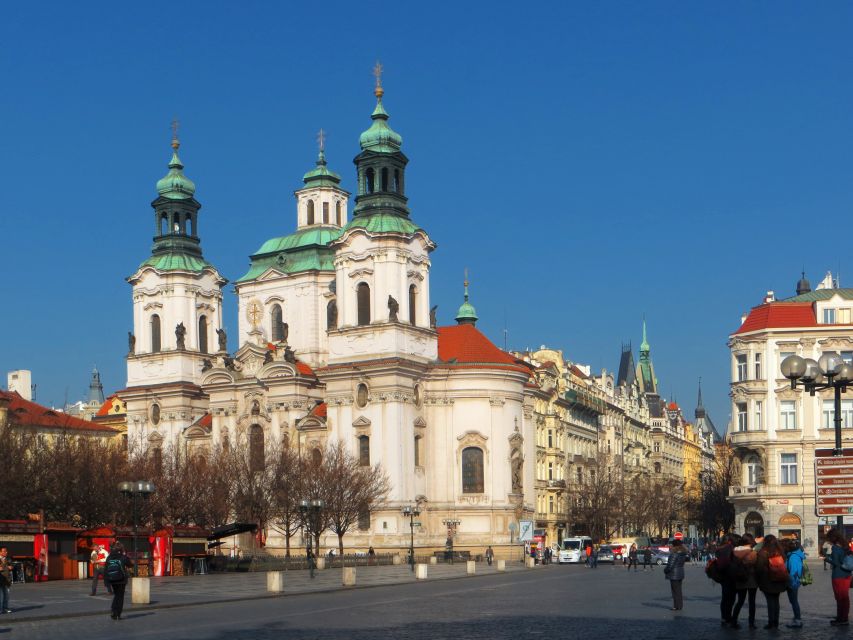
The starting point is Týnská 627/7, at building number 7. To find it, stand behind Týn Cathedral and look for the large wooden door. This is worth noting because Old Town’s small lanes can make a simple address surprisingly hard to spot.
The walk finishes at Old Town Square, so the beginning and end both sit in the historic core. There is no hotel pickup, and the activity is entirely on foot. Wear shoes that can handle uneven city streets, since the route moves through old lanes and open squares.
The small-group cap is 15 people. That is not the same as a private tour, but it is much more manageable than a large city walk. If you want a group just for your party, a private option is available.
Old Town Square, Jan Hus, and the Astronomical Clock
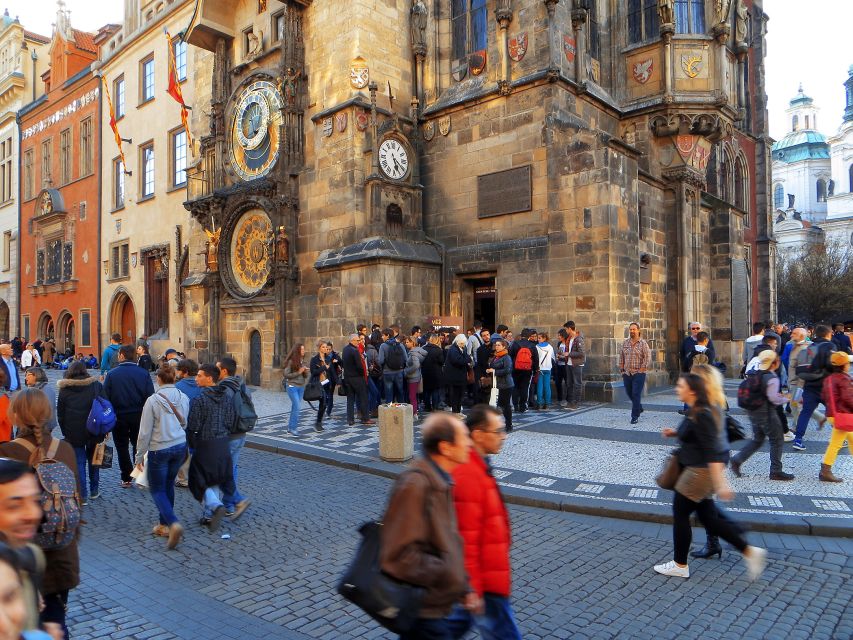
The first major section centers on Old Town Square, Prague’s great stage for public life. You see the House at the Stone Bell, the Jan Hus Monument, and the famous Astronomical Clock, with the guide explaining how these places fit together.
The House at the Stone Bell, or Dům U Kamenného zvonu, is one of the square’s most notable historic buildings. Its name comes from the stone bell on the exterior. On this walk, you receive a guided explanation rather than an interior visit, so the value comes from the building’s setting and the story attached to it.
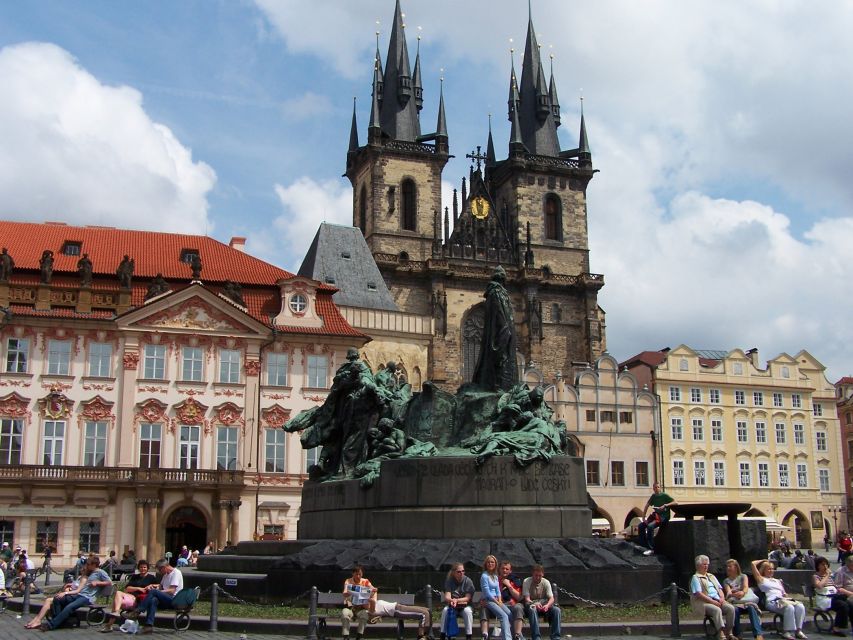
The Jan Hus Monument gives the tour a more serious turn. Hus was a religious reformer and an important figure in Czech national memory. His fate helped shape later religious conflict in Bohemia, so the monument is not simply a statue in a pretty square. It helps explain why Czech history often feels closely tied to arguments about faith, language, power, and independence.
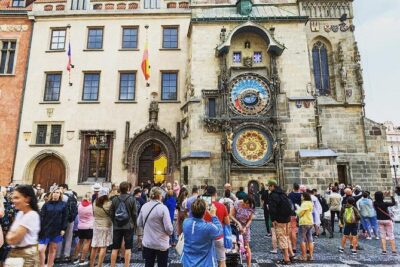
The Astronomical Clock is the square’s biggest crowd magnet, but the tour helps you look past the hourly show. You hear about the curious symbols, the clock’s display, and the figures that make it more than a timepiece. The guide can also explain why the clock matters to Prague’s public image and daily city life.
This part can feel busy, especially around the clock. The benefit of a guide is that you do not need to know where to look or what questions to ask. The limitation is that two hours does not allow a long pause for photographs or a detailed examination of every façade.
Charles University and Prague’s place in Central Europe
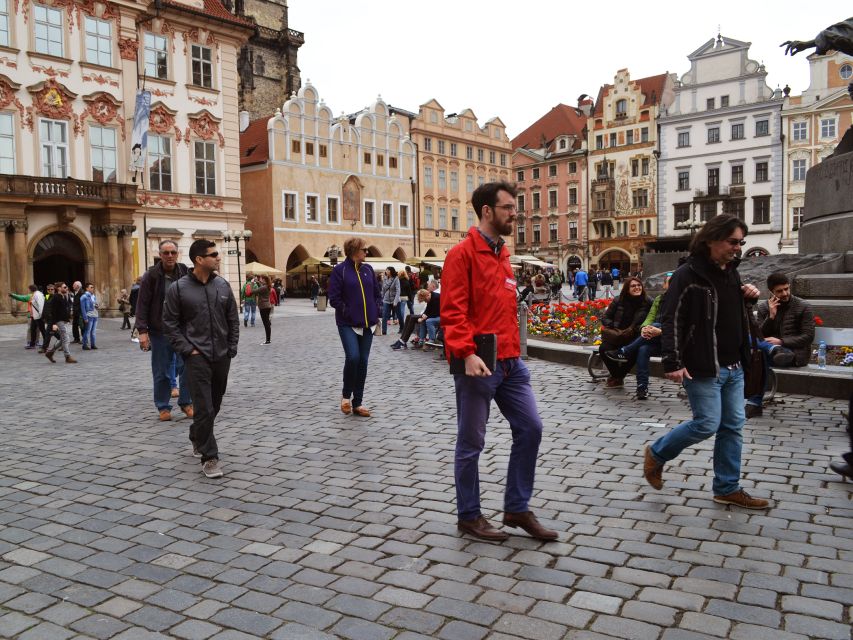
The route continues past the Karolinum complex, connected with Charles University. This is one of the most useful stops for understanding Prague as a center of education and culture.
The university dates to the 14th century, while the buildings you see in the Karolinum complex include later historic layers. The tour presents the site as part of Prague’s larger role in Central Europe, where education, religion, politics, and culture repeatedly crossed paths.
I like this stop because it moves the tour beyond postcard Prague. The Old Town is not only towers and decorative façades. It was also a place where scholars studied, institutions gained influence, and ideas moved through the region.
You should listen for the connections between Bohemia and the later Czech Republic. The guide’s job here is to explain the broad changes over time, not to give you a specialist lecture on the university. If you already know Prague’s history well, this section may feel introductory. If you are seeing the city for the first time, it helps put later sights in context.
More Walking Tours in Prague:
- Prague: 3-Hour Walking Tour of Old Town & Prague Castle
★ 4.7 · 5,696 reviews - Prague: Ghost Walking Tour Where Legends Come To Life
★ 4.4 · 5,253 reviews - Prague Guided Walking Tour and Cruise with Authentic Czech Lunch
★ 5.0 · 3,627 reviews - Prague Ghost and Legend of Old Town Walking Tour
★ 4.5 · 2,630 reviews
Estates Theatre and the House of the Black Madonna
The Estates Theatre, or Stavovské divadlo, adds a cultural stop to the route. The 18th-century façade belongs to Prague’s historic theater district, and the building represents the city’s long connection with music and performance.
The stop is especially useful if you want to understand Prague as more than a medieval-looking capital. The theater setting shows how the city developed cultural institutions alongside churches, universities, and political buildings.
The tour then reaches the House of the Black Madonna, a famous example of Czech Cubist architecture. Its sharp geometric design looks different from the older buildings around it. That contrast is part of the point: Prague’s center contains several architectural periods close together, and a walking tour lets you notice those changes in sequence.
The Church of St. James follows. Here, the guide points out another religious landmark and adds to the story of the city’s churches. Again, the visit is guided from the outside. If you want to see church interiors, you will need to return separately.
This cluster of stops makes the route feel varied. You move from university history to theater, modern architecture, and religious buildings without needing public transport. The cost is that each place receives only a short explanation.
Entering Josefov, Prague’s former Jewish quarter
The most distinctive part of the tour is the walk through Josefov. This small quarter is surrounded by the Old Town, yet its history is separate and often painful. The guide explains the cramped conditions of the former Jewish Ghetto and what happened when the area was destroyed and rebuilt in the early 20th century.
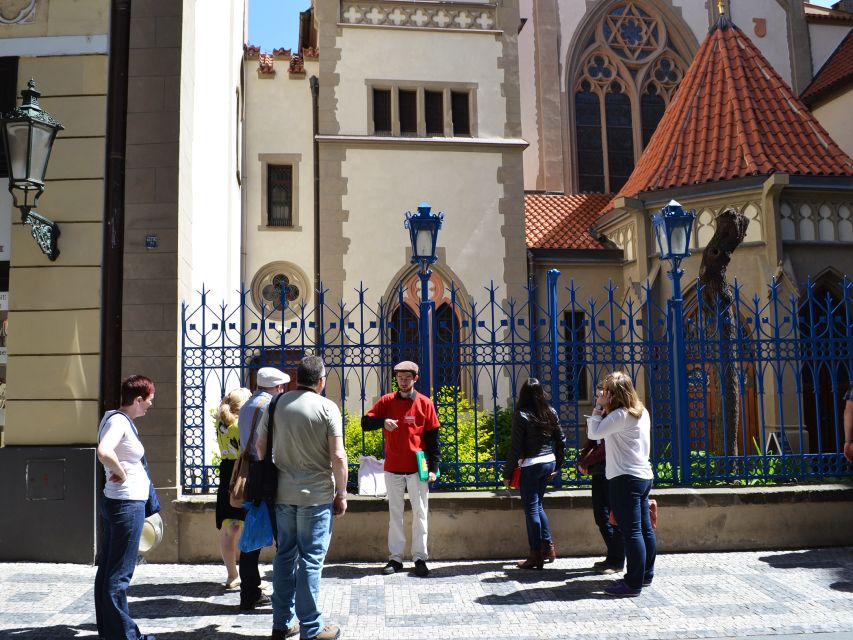
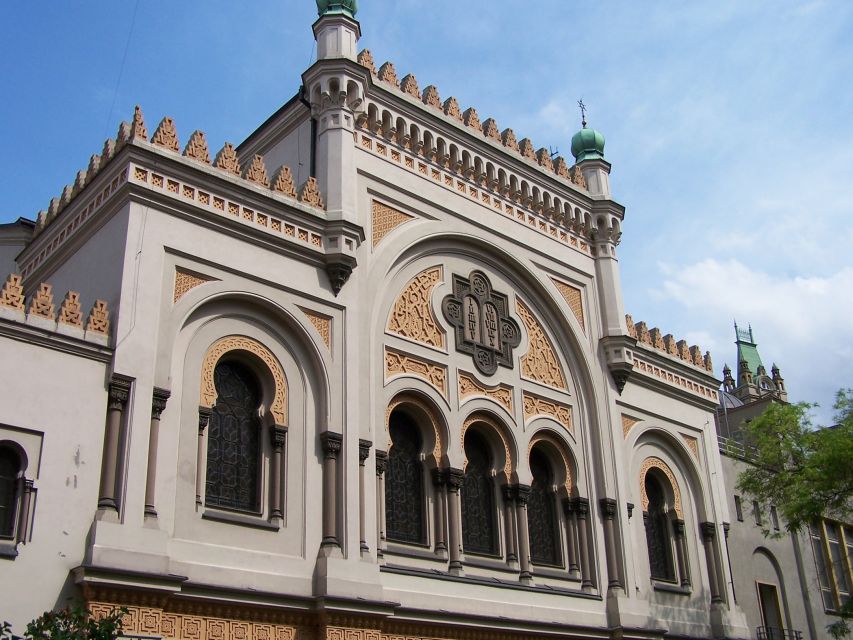
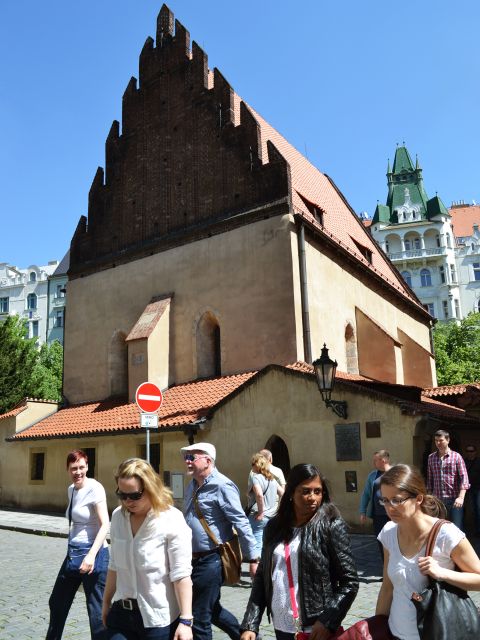
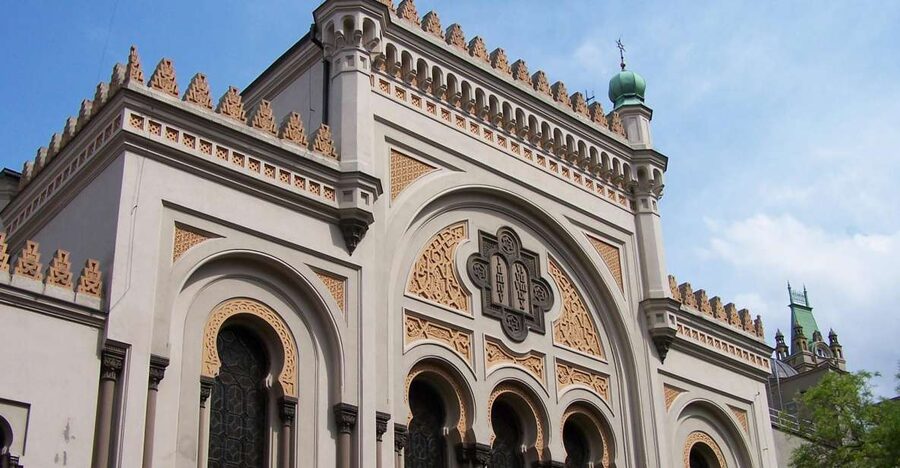
The route includes the Maisel Synagogue, Old Jewish Cemetery, Klausen Synagogue, Old-New Synagogue, and Spanish Synagogue. You see the buildings from the outside and learn how they fit into the old quarter.
The word ghetto needs care here. This was not simply a charming old neighborhood. Jewish residents were confined to a restricted area, and overcrowding shaped everyday life. The tour’s value is in showing you the physical closeness of the quarter and explaining why Josefov cannot be treated as just another collection of attractive façades.
The Old Jewish Cemetery is one of the most powerful exterior stops. Its crowded appearance reflects centuries of limited space. You may find the guide’s explanation more meaningful than a quick photograph, especially if you have not studied Prague’s Jewish history before.
The Old-New Synagogue is another key sight. Its age and continued importance make it central to Josefov’s story. The Klausen and Maisel synagogues add further layers, while the Spanish Synagogue brings a different architectural character to the route.
A guide can also explain the legends connected with Josefov, including the story of the Golem. Treat this as folklore rather than a proven event, but it offers a window into how Prague’s Jewish quarter has been remembered and imagined.
The biggest limitation is simple: you do not go inside. The Jewish Museum complex includes interiors that require separate admission, and this walking tour does not provide that entry. If the synagogues and cemetery are your main reason for visiting Josefov, plan another visit with enough time for the interiors.
Franz Kafka’s Prague and the final walk back
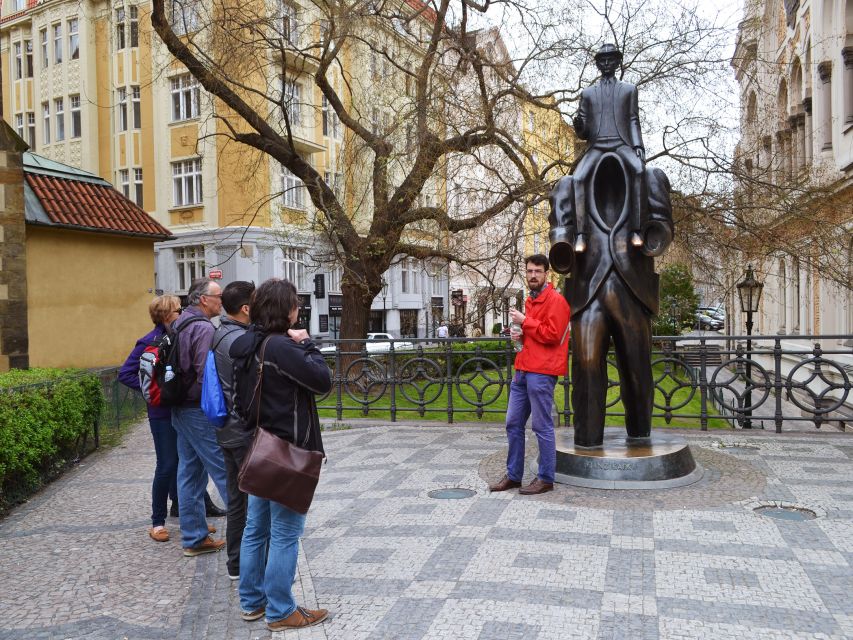
The route includes Franz Kafka’s birthplace and the Franz Kafka Monument. These two stops connect the city’s physical streets with one of Prague’s best-known writers.
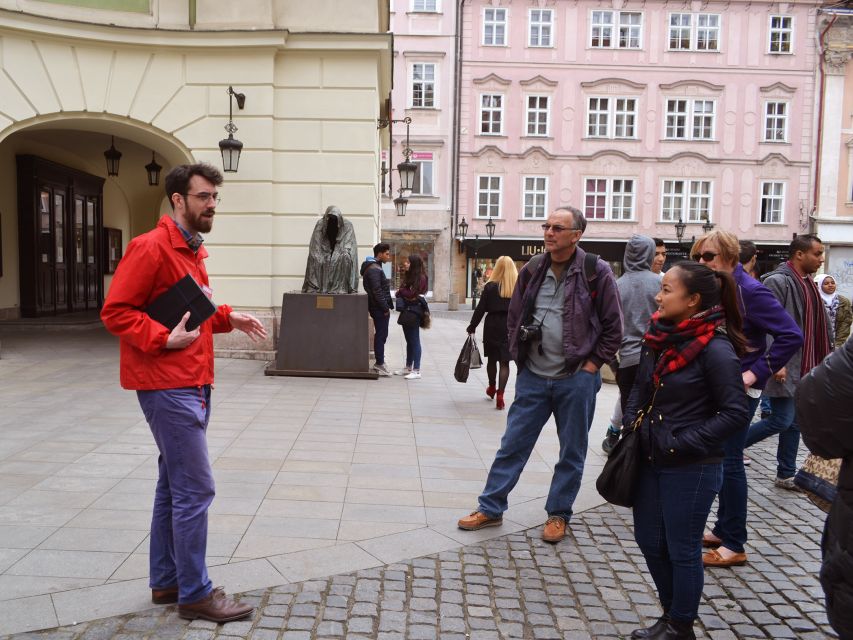
Kafka’s birthplace gives you a direct sense of how closely his life was tied to the Old Town and Jewish quarter. The Kafka Monument adds a more modern and symbolic note. Together, they show how Prague’s identity includes both historic buildings and later artistic interpretations of the city.
I find this a good ending because Kafka’s work is often linked with Prague’s uneasy, layered character. The city can look orderly and ornate, yet its history contains tension between communities, languages, religions, and political powers. A strong guide can make that connection without turning the stop into a literature lecture.
The walk ends at Staroměstské náměstí, the Czech name for Old Town Square. That makes the finish convenient for continued sightseeing, a meal, or a return to a nearby hotel, though no hotel transfer is included.
Guide quality and the pace of the experience
The guide is the main variable in a walking tour like this. The most praised guides on this experience include Krystoff, Allen and Allan, Radek, Dana, and Martin. Their strengths were clear explanations, enthusiasm, humor, and a willingness to use maps, photographs, or a notepad to clarify complicated points.
One especially useful feature is the guide’s ability to explain both Christian and Jewish Prague. Many quick Old Town walks focus almost entirely on royal buildings and the clock. This route gives Josefov enough space to make the city’s religious and social divisions part of the main story.
The pace remains brisk. You stop at many locations in 120 minutes, so expect short talks rather than long periods at each monument. If you want detailed architectural analysis, extended photography time, or interior visits, this should be your starting walk, not your only Prague activity.
The tour is offered in English. A private group is available if you want more control over the pace or prefer to keep the discussion within your own party. For most people, the small public group should be adequate, particularly with a maximum of 15.
Is $23 good value for two hours?
At $23 per person, I consider this good value for a first visit. You are paying for a live guide, a carefully connected route, and context that is hard to gain from simply walking between famous sights.
The price is strongest if you use the tour as a city orientation. You can later return to the Astronomical Clock, churches, synagogues, cemetery, or Kafka sites with a better understanding of what you are seeing.
The value is weaker if you expect admission to major attractions. The guide is included, but entrances are not. You should budget separately if you want to visit the interiors of the synagogues, cemetery, churches, or other buildings.
Free cancellation up to 24 hours before the start and reserve-now, pay-later booking make it easier to fit into a changing schedule. Check the available starting times before booking, since the tour lasts exactly two hours.
Who should book this walk?
I would recommend it to first-time visitors, history-minded couples, solo visitors who want an informed introduction, and families with older children who can manage a steady city walk. It also suits anyone who wants both Christian and Jewish history in one route rather than booking two separate introductions.
It is less suitable if you have already taken several Prague history tours or know the Old Town well. In that case, the broad explanations may feel familiar, and a more specialized tour could offer greater value.
It may also disappoint you if your main goal is entering the synagogues or spending quiet time in the Old Jewish Cemetery. This experience explains those places from the street. It does not replace a visit to the Jewish Museum complex.
Should you book the Prague Old Town and Jewish Ghetto tour?
Book it if you want a clear, compact introduction to Prague’s historic center for $23. The route covers the Astronomical Clock, Jan Hus, Charles University, the Estates Theatre, Josefov’s synagogues, Kafka, and the major Old Town sights without wasting time on transport.
I would schedule it near the start of your stay and use the rest of your trip for interiors and slower visits. Choose a private group if your party wants a custom pace. Skip it only if you already understand Prague’s central sights or need a tour centered on synagogue and cemetery entry.
FAQ
How long does the Prague Old Town and Jewish Ghetto tour last?
The walking tour lasts two hours.
How much does the tour cost?
The listed price is $23 per person.
What language is the tour offered in?
The live tour guide speaks English.
Where does the tour begin?
It begins at Týnská 627/7. Once you are behind Týn Cathedral, look for the large wooden door at building number 7.
Where does the tour finish?
The tour finishes at Staroměstské náměstí, or Old Town Square.
What sights are included on the route?
The route includes Old Town Square, the House at the Stone Bell, Jan Hus Monument, Prague Astronomical Clock, Charles University, Estates Theatre, House of the Black Madonna, Church of St. James, Maisel Synagogue, Old Jewish Cemetery, Klausen Synagogue, Old-New Synagogue, Spanish Synagogue, Franz Kafka’s birthplace area, and the Franz Kafka Monument.
Does the tour include entry to the synagogues or other buildings?
No. Interior visits are not included. The sights are viewed and explained from the outside.
How large is the group?
The group can include a maximum of 15 people. A private group option is also available.
Can I cancel or pay later?
You can cancel up to 24 hours in advance for a full refund. Reserve-now, pay-later booking is available.
Newest listings in Prague
- World War II 4WD Tour from Prague with Lunch★ 4.4 · 3 reviews
- Prague: Historical Walking Tour with Focus on World War 2★ 4.3 · 12 reviews
- WWII and Communism History in Prague’s Old Town Private Tour★ 5.0 · 4 reviews
- Wroclaw: Giant Mountains & Valley of Palaces Day Tour★ 4.8 · 36 reviews
- Walking tour of Prague in French : Nové Město★ 4.9 · 16 reviews
- Walking tour of Prague in french: Old Town & Charles Bridge★ 4.9 · 62 reviews
- Vltava River Cruise and Private Tour of Prague’ Old Town★ 5.0 · 1 review
- Ultimate Unlimited Beer Pong with Czech Beer★ 4.6 · 5 reviews
Jewish Quarter Tours, compared.
Jewish Quarter Walking Tour with Admission Tickets
Read our review →
Old Town and Jewish Quarter Guided Walking Tour
Read our review →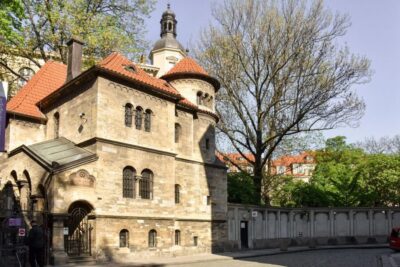
Jewish Quarter Ticket with optional Audio Guide
Read our review →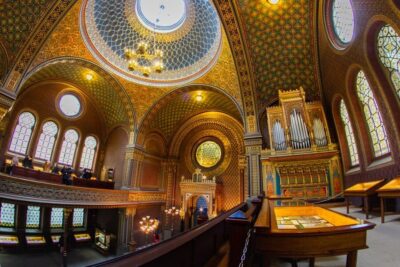
Prague’s TOP Sights – Old Town, Jewish Quarter, Charles Bridge (Tip-based tour)
Read our review →
Prague Old Town New Town and Jewish Quarter Morning Tour
Read our review →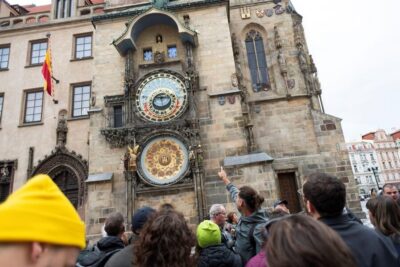
Old Town, Jewish Quarter & Astro Clock Walking Tour
Read our review →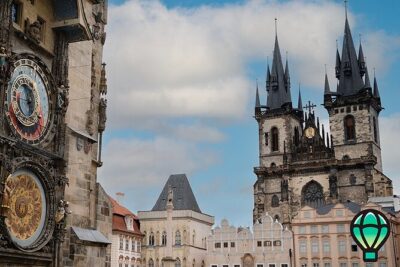
Prague Essential Tour Old Town and Jewish Quarter
Read our review →Browse the lists this tour appears in